Protect Your Links for Partners and Staff
Learn how to protect your links so exclusive codes stay with partners, staff, and influencers instead of public coupon sites.
A creator post can do its job and still wreck the margin. The visit was real, the code was exclusive, and by the time finance looks at the order the fee has gone to a coupon placement that never made the sale. The shopper who pasted the string is not the villain. They saw a deal and tried to use it. A blank error protects the discount and often loses the cart. Letting every typed code through protects the cart and pays the wrong partner.
When you protect your links, you are doing two jobs at once. The right partner keeps the credit, and a real shopper is not punished at checkout. Exclusive offers should fail without their link. Public sales can still use a code that is meant to travel. Those are different tools.
I would not rebuild the whole promo calendar in one sitting. Lock the offer that already escaped, hand over the link instead of the string, and prove the bare code does nothing.
Who Should Redeem an Exclusive Link
A creator code left your outbox at 9 a.m. By lunch it was on a coupon forum, and the commission followed the repost instead of the creator. Checkout still took the string because the offer was something anyone could type. That is a leak and an attribution miss in the same order.
A protected link is permission that lives on the URL. It is not a code the internet can paste into a box. Exclusive offers should fail when that link is missing. A public sale is the exception, and it needs a different code you expect people to share.
| Audience | Bare code works | Link required | Redemption cap | Expiry | Affiliate fee |
|---|---|---|---|---|---|
| Employee perk | No | Yes | 1 per person | Quarter or employment | None |
| Influencer campaign | No | Yes | Campaign total and 1 per customer | Campaign end date | Only that creator |
| Regional or wholesale partner | No | Yes | Contract volume | Contract term | Contract rate only |
| Public sale | Yes, on a separate code | No | Optional | Sale window | None |
| Copied or leaked code | Must fail | Not valid alone | Revoke remaining uses | Immediate | None |
Employee perk. Staff need their own link, one use per person, and no affiliate fee. This row stops a forwarded staff URL from becoming a public coupon. Add a login step. The staff link applies only after the redeemer signs in with a work account, so a forwarded URL fails for anyone outside the team.
Influencer campaign. Each creator gets their own token, a campaign cap, one use per customer, and an end date. One post cannot outlive the campaign, and a coupon site that copies the string cannot collect that creator's fee.
Regional or wholesale partner. Lock product scope, currency, and market. The failure you are blocking is a code that still discounts a cart in another country, in another currency, on products the contract never covered.
Public sale. Use a separate code that is allowed to travel, with an optional cap, a sale window, and no affiliate fee. Do not point that public string at the same token you gave a creator.
Copied or leaked code. It must fail on its own. Revoke whatever uses remain, and pay no fee on it.
Hoping recipients keep codes private does not scale. In 2024, retailers issued an average of nine unique promotional codes during the first six months of the year, a 31% increase from the prior year, according to data reported by Retail Brew.
Same-day test: Enter the bare code with no link. If checkout still discounts, that offer is not protected.
How to Bind Each Code to One Link
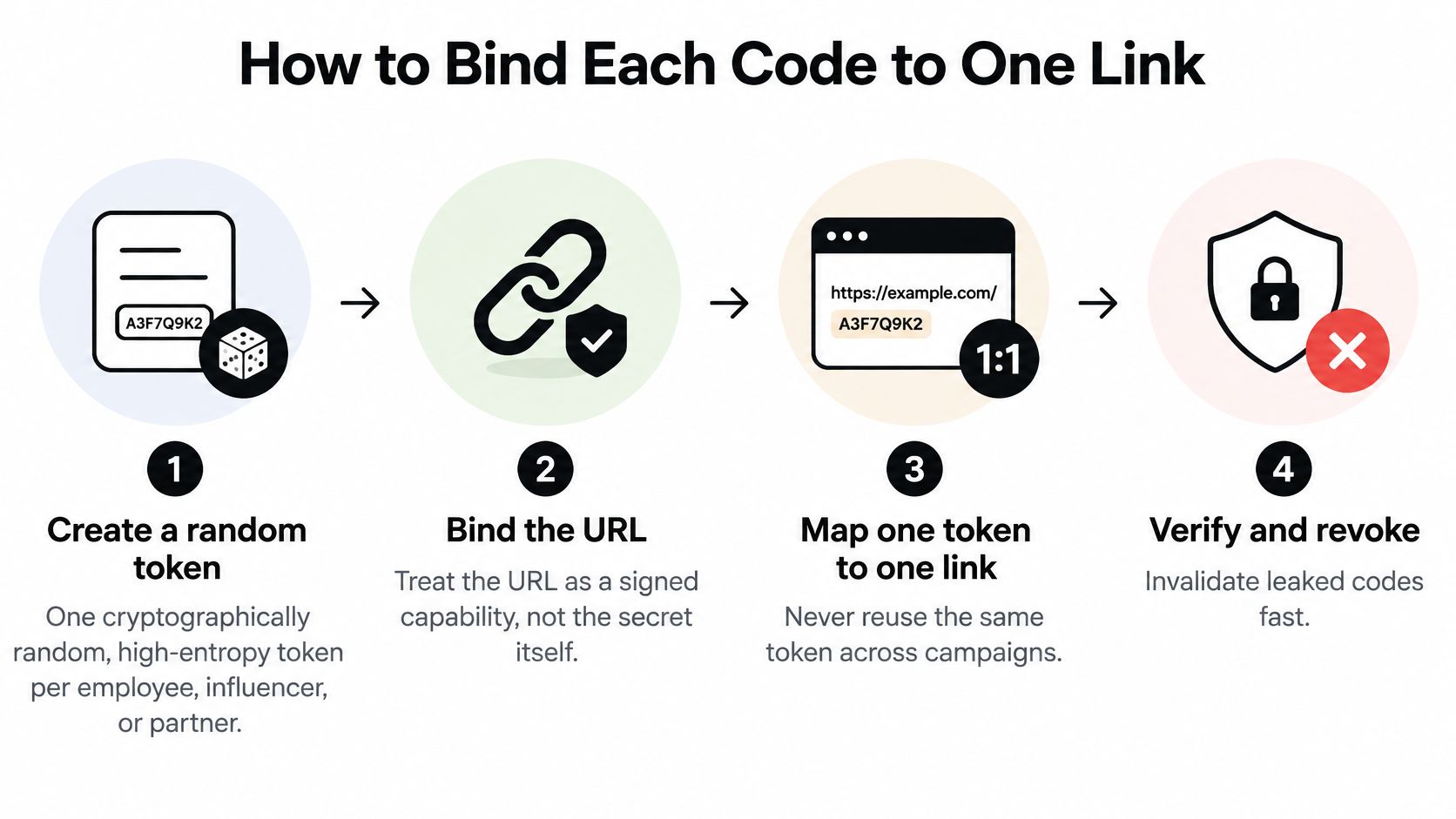
Treat the URL as a signed capability, not as the secret itself. A vanity string like STAFF20 is a password printed on a billboard. A random token your server checks is a key you can revoke.
The OWASP CSRF prevention cheat sheet recommends binding signed tokens to session-specific data and using HMAC when tokens hold sensitive claims. Signing alone, without that binding, leaves the door open to token injection and replay.
Build one token for one link
Create one random token. Generate a cryptographically random, high-entropy token for each employee, influencer, or partner. Never reuse a pretty code across campaigns. This stops one leaked vanity string from exposing every offer you have ever run.
Bind the claims. Attach audience, campaign id, permitted discount, currency, region, product scope, expiry timestamp, total redemption limit, and one-use-per-customer. Add customer identity when the offer is personal. Binding is what stops a valid signature from being reused on a different deal.
Sign with a server-side secret. Use HMAC, and never put raw customer data in the query string. An email or name in the URL is its own leak. A homegrown token format can also add injection bugs if you invent the encoding as you go.
Validate before any discount. At checkout, check signature, expiry, audience, region, and remaining uses. Reject the bare code if the signed link is missing. A token that looks fine but skips a server-side redemption check is only a sticker.
Log every attempt, including replays. When the quota is hit, kill the forwarded link. Without a log you cannot tell a second real order from someone replaying the same URL.
Scope, stacking, and the numbers that matter
A signed URL can still be forwarded. Keep it short-lived and narrowly scoped. OWASP notes that URL signing restricts access, and also warns that an anonymously shareable signed URL can still expose the resource once someone forwards it. Custom generation can introduce injection risks, so do not bolt extra parameters onto the link after it is signed.
Do not let the exclusive offer stack with another discount. A clean token plus a sitewide code is how a 15% creator cut becomes 30% at the register. Accepting the token without a remaining-uses check is the other common miss. The signature can be perfect and the quota already spent.
Hand the partner the link, not the raw code, and tell them the bare code will fail on purpose. That sentence prevents the "it didn't work, so I posted the characters" ticket.
Measure unauthorized redemption rate, replay attempts per 1,000 links, valid-link conversion, and false-block rate. A sound design cuts unauthorized redemptions without crushing legitimate campaign conversion. If valid-link conversion drops hard while replay attempts stay flat, the link is too brittle, not the audience.
A Weekly Routine That Kills Leaked Codes
A one-time setup fails because most codes never die. One analysis of 117 million discounts found that one-third lacked a redemption cap, 90% had no expiration date, and the average code was 2.5 years old. A separate 24-month look at 1.14 million orders and $29.4 million in discounts put discounts at 10.3 cents per gross sales dollar, with 86% of leakage outside November and evergreen codes as a major driver. Seguno's account of those Shopify discount analyses is directional. The samples are not every merchant.
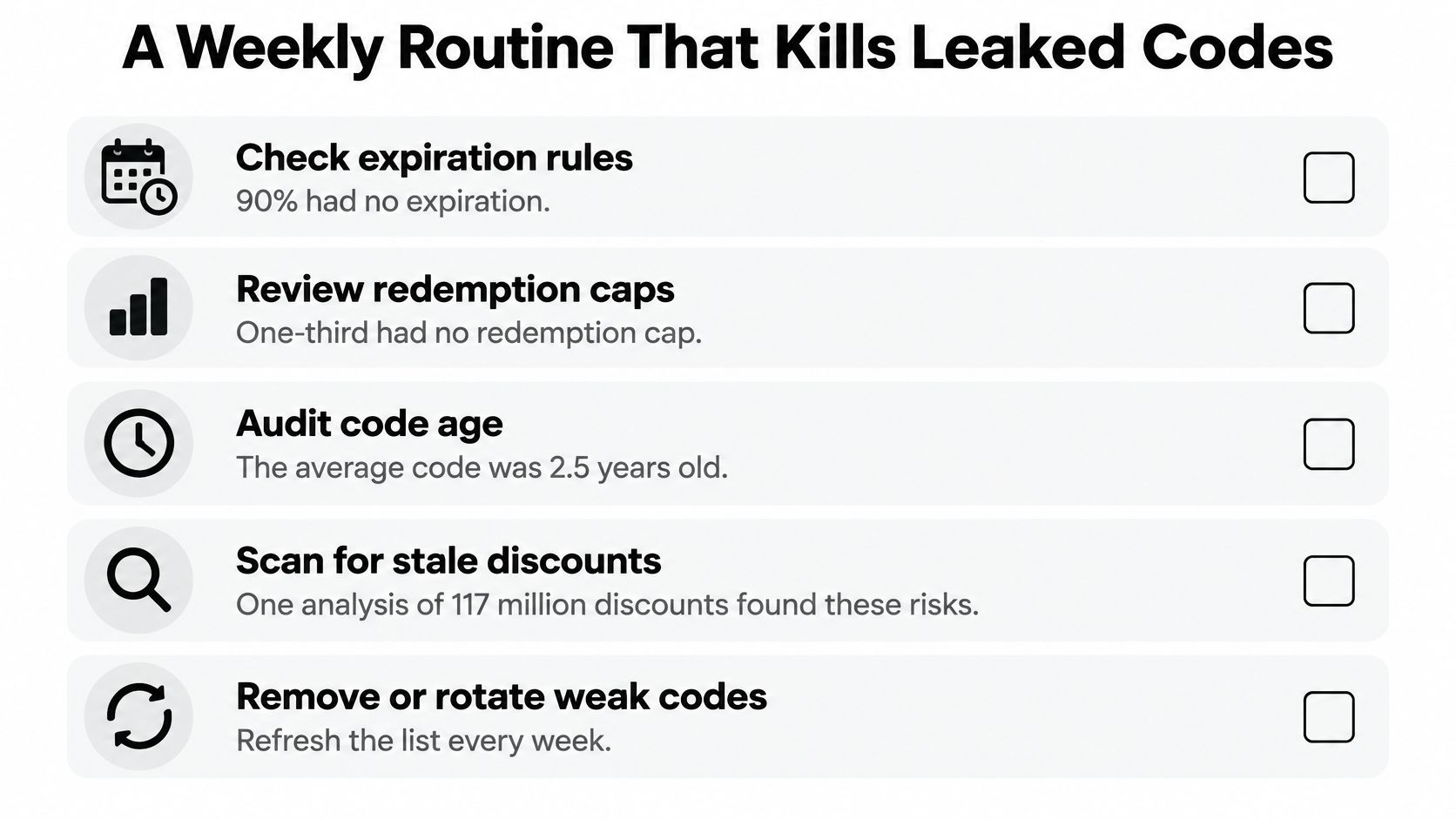
Six moves, then the log
Inventory every live code and link. Name an owner, audience, region, currency, product scope, start, end, total cap, and one-use-per-customer rule. A row with no owner is still redeeming next year.
Scan daily or weekly. Cover search results, coupon sites, forums, and affiliate placements. Famous coupon brands are not the whole map.
Classify the hit before you touch it. The table below is the whole decision. Killing an approved partner page because it "showed up in search" is how you lose the partner.
Revoke or rotate the exposed token, then issue a fresh link only to the legitimate owner. Tell that owner before you rotate, or you punish the person you meant to pay. A practical pass on exposure sits in this guide to a discount code leak.
File a removal request and track it until the listing is gone. A sent email is not a removal.
Compare redemption logs and margin before and after. Takedown count is a vanity metric. Recovered margin is the number that pays rent.
How to class a found code
| Where it showed up | Class | What to do | Who to update |
|---|---|---|---|
| Agreed creator or partner page, still in dates | Authorized | Leave it | Nobody |
| Past end date but still redeeming | Expired | Disable the token | The original owner |
| Coupon site, forum, or reseller post | Leaked | Revoke, rotate, request removal | Owner gets the new link only |
| Lookalike domain or fake storefront | Impersonated | Kill the offer and warn the list | Partners and support |
| Unknown regional mirror | Leaked | Revoke and rescan that market | Regional owner |
Track gross-margin cost per code, unauthorized share of redemptions, time-to-removal, and expired-code checkout attempts.
The usual misses are small and expensive. Teams watch only famous coupon sites, rotate a code without updating the partner, ignore regional mirrors, and celebrate removal volume while the same string still redeems.
A removed listing that still redeems is not a win.
Tips for Keeping Credit With the Right Partner
The fee often leaves with the screenshot, not with the creator. Coupon and cashback publishers are commonly paid per sale, and they show up late, sometimes at checkout, when the shopper was already buying.
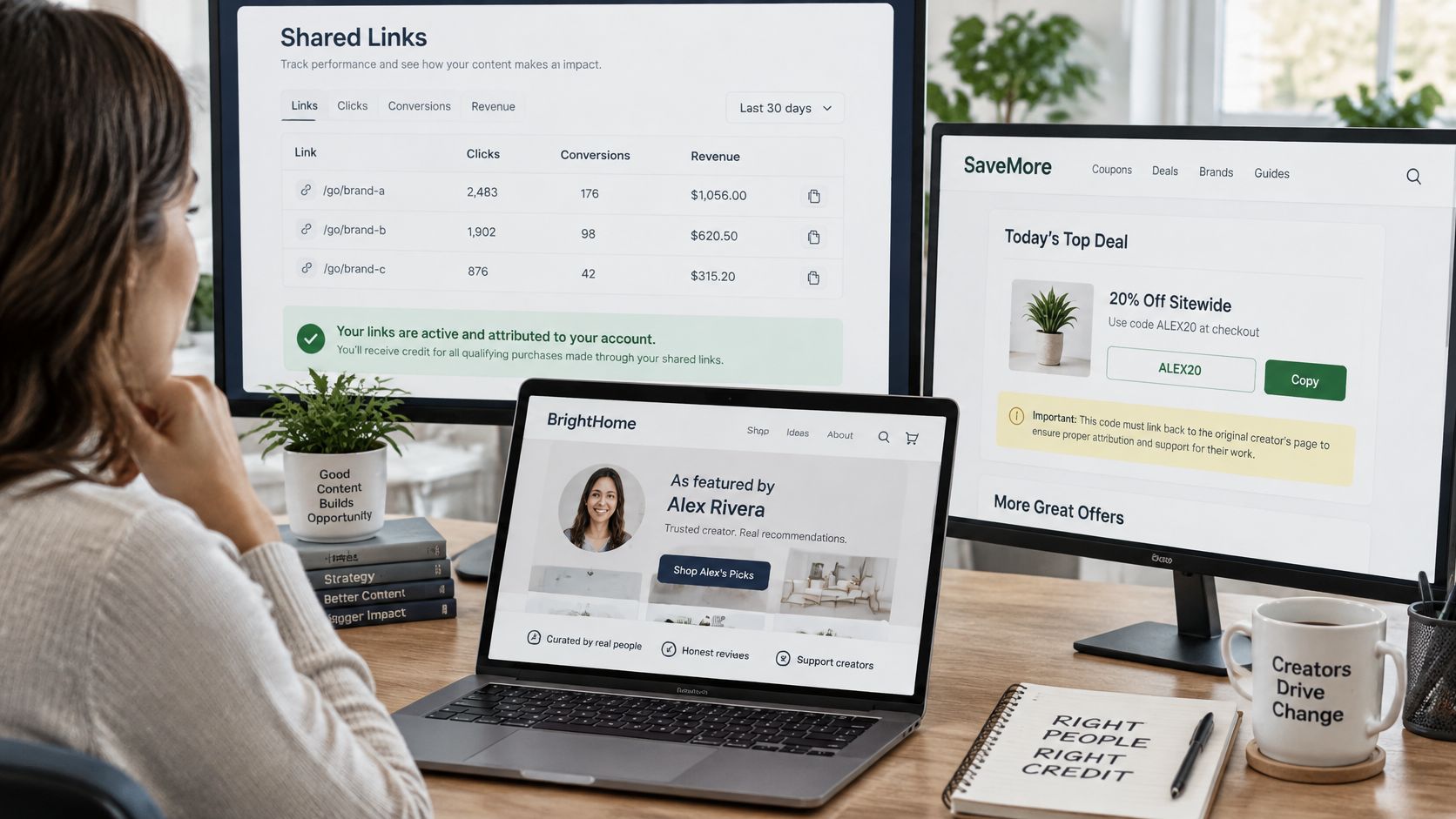
A leaked creator code on a coupon site can pay the poster. You still fund the discount. The creator who produced the visit gets a zero. That is an attribution rule failing in public, not a fraud team missing a villain.
Four decisions before peak season
Prefer one creator link with a use limit. A code the whole internet can type will be typed. A single-creator link with a cap cannot be screenshotted into a working offer. Tell creators the link is the offer, so a picture of the code is useless. Set that expectation when you scope influencer discount codes, before the first post goes live.
Do not auto-apply anything the store did not approve. An extension that injects a string at the last second is not a referral. It is a claim on a sale that already existed.
Score the injection with four numbers. Incremental orders, discount cost, commission cost, and the original referral. If the extension adds no real cashback and no disclosed benefit, block the injection and swap in a valid code that pays no stray commission. Leave a transparent, shopper-chosen referral alone. Blocking every extension is the blunt version. Selective blocking is the one that keeps honest cashback.
Review last-click rules before the rush. A Honey-style extension can overwrite the influencer who drove the visit if you pay whoever touched the cart last. Change that rule before the peak, not during it.
An attribution analysis put the average incrementality of coupon and deal-site affiliates near 29%, which would mean about 71% of those attributed conversions may have happened without the affiliate. Hamster Garage reports that as an industry estimate, not a universal rate. Run your own holdout before you treat 29% as your number.
If you want the last-click grab in motion, this walk-through shows where the extension sits in the cart:
I would not pay a late coupon placement the same rate as a creator who produced the visit. Pay the partner whose link was the offer. Everyone else can still help the shopper, just not with your exclusive cut and not with that creator's commission.
What to Offer When the Code Fails
Shoppers don't trust codes, and they still need them. In 2025, 39% of surveyed US consumers called online coupon codes unreliable, while 82% said coupons help them handle high prices. The same briefing projects promotion and loyalty abuse rising from 31% to 42% of total fraud within two years, while only 20% of organizations automatically enforce promo-code limits, per Savings.com. A hard error saves margin. It can also empty the cart.
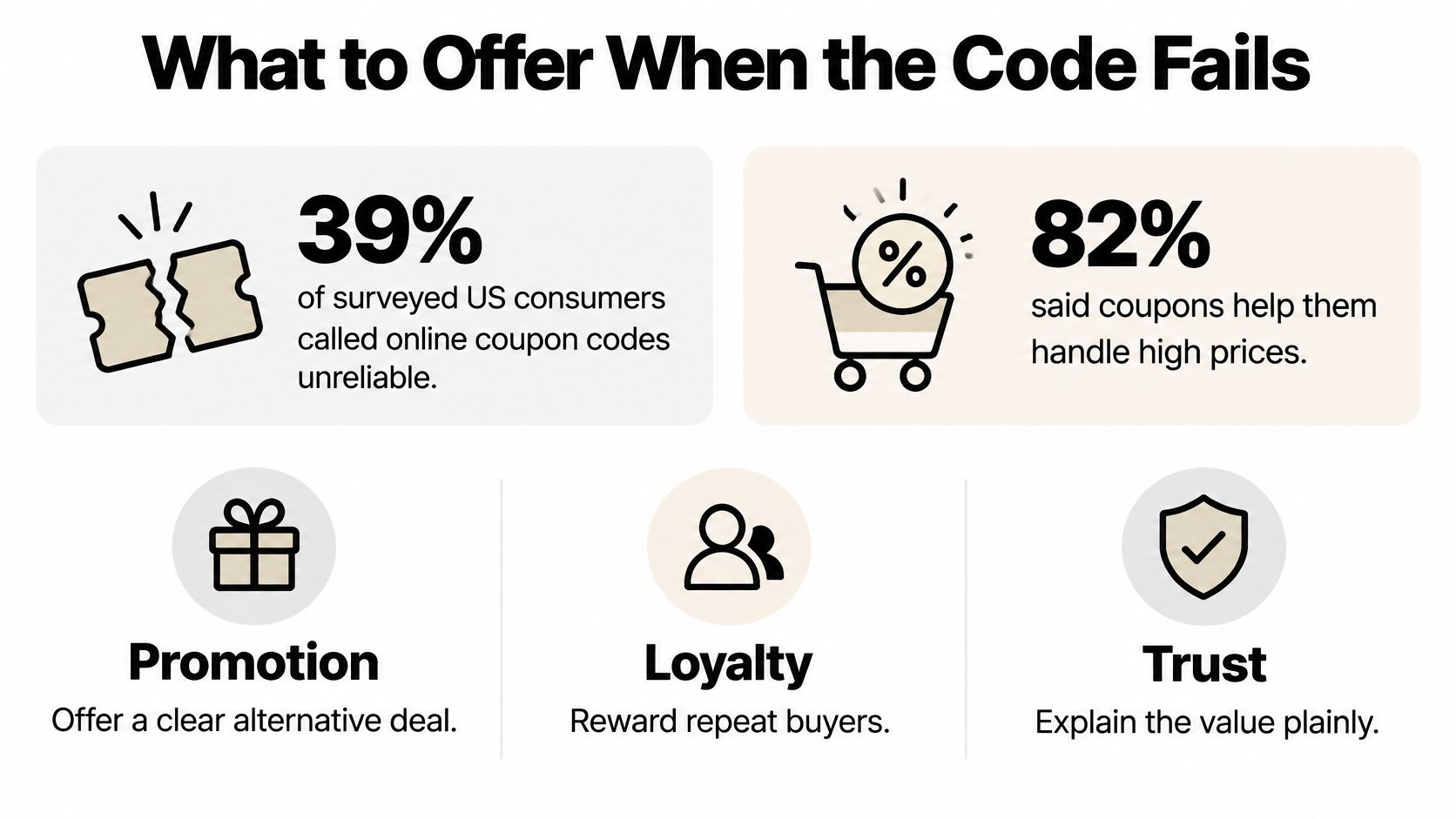
Set fallback rules before launch, by audience, region, currency, expiry, and order value. Do not invent them in the support queue.
Fallback rule by failure type
| Failure | Who gets a fallback | What the shopper sees | Margin rule |
|---|---|---|---|
| Forwarded staff link | Not the employee | Support script, no discount | Full discount stays with staff only |
| Expired influencer link | Verified creator audience | Smaller merchant-set replacement | Margin floor set before launch |
| Region or currency mismatch | Shopper in another market | Local offer for that market | Same margin rule per market |
| Below minimum spend | Intended audience | Cart message showing the gap | No discount added |
| Copied or leaked code | Anyone without the link | Non-discount perk such as free shipping over a threshold | Shipping cost capped |
A staff link used by the employee still applies. A forwarded staff link does not, and support gets a short script instead of a discount. An influencer link past its date can offer a smaller merchant-controlled replacement, not the original deep cut. A region or currency mismatch points the shopper to the local offer rather than a global code. A code that misses a minimum spend should show the gap in the cart, not a blank rejection.
Choose a replacement discount when the shopper is clearly in the intended audience and the margin still works. Choose a non-discount perk, such as free shipping over a threshold, when the code was copied. Cap that shipping cost so the perk cannot outrun the discount you refused. If two promotions can combine, the smaller offer becomes the deep cut again, which is why coupon stacking belongs in the rule before you switch the fallback on.
Reject the code, not the customer.
Measure recovery rate, margin kept, and support contacts. High recovery with the margin floor intact means the fallback is working. A spike in support contacts means the cart message is unclear, not that the rule was wrong.
Turn On Link Protection for Your Store
Match the first move to the mess you have.
Codes are still typed freely. Stop issuing exclusive offers as plain strings. Move employees, influencers, and partners onto links that fail without the designated URL.
Leaks are already public. Run the daily scan and a tracked removal. Update the partner with a new link before you rotate their token.
Checkout extensions are taking the last click. Block unapproved injection, and keep a non-commission valid code for shoppers who were already going to buy.
Failed codes are pushing people out of checkout. Turn on the merchant-set fallback for the audiences that qualify. Everyone else gets a clear reason, not a dead error.
For Shopify brands, KeepCart Protected Links lock exclusive employee, influencer, and partner codes so they redeem only through the designated link, with leak monitoring beside that work so you aren't auditing coupon sites by hand. Nordic Visual in Denmark described the effect this way: "It has been a key tool for protecting our checkout from unintended discounts and coupon misuse, especially from extensions and affiliate-related leaks."
The action this week is one audience, one token, one cap, one expiry, and a bare-code test that must fail.
KeepCart locks exclusive partner and staff offers to a designated link, watches for leaks, and can swap a failed code for a merchant-set fallback so checkout doesn't end on a blank error. If a creator code is already on a coupon site, or a staff perk still works when someone types it, that is the week to fix one audience. Visit KeepCart and run the bare-code test on the offer you cannot afford to leave open.