Discount Code Leak: How to Spot and Contain It
Learn how a discount code leak happens, how to spot the signs in your redemption data, and the steps to contain it before margins suffer.
Your best performer's code did 40 redemptions in its launch week. Last night it did 90. The orders are real, the discount is real, and none of those buyers watched the video the code was cut for.
That's what a discount code leak looks like from the inside. It rarely arrives as a fraud alert. It shows up as a code that suddenly works a little too well, in regions you don't ship to often, on accounts created the same afternoon, attributed to a creator who hasn't posted in three weeks. The discount went out the door, the commission went with it, and the campaign report calls it your best month yet.
Where Discount Codes Leak From
A discount code is an authorization token in a friendly disguise. The store issued it to a named audience: employees, one creator's followers, a partner's customers, a single market. The moment that string escapes the audience, everyone who finds it holds the same permission the intended group had. Picture a spare key cut for a house sitter. One copy is sensible. Four copies passed around and nobody can say who holds one.
Six channels do most of the damage, and each leaves its own footprint in redemption data.
| Leak source | How the code escapes | Signal in your data |
|---|---|---|
| Coupon sites and forums | Listed by users or scrapers | Redemptions from unknown referrers |
| Browser coupon extensions | Applied automatically at checkout | Orders with extension referrer but no affiliate click |
| Influencer or affiliate posts | Code outlives the campaign or is reposted | Redemptions after the campaign end date |
| Employee or partner sharing | Staff or partner code passed to outsiders | Spike from one region or one customer segment |
| Private deal groups and social posts | Shared in communities | Uneven redemption volume with no campaign running |
| Unrestricted campaign links | Code valid for anyone who finds it | Redemptions outside the intended audience |
The last row is the one most brands build themselves. A campaign link with no eligibility rule isn't a restricted offer, it's a public one that started life as a private plan. The first two rows spread fastest because neither needs your cooperation: a coupon site listing appears without your consent, and a browser extension doesn't care whether the shopper ever saw the code in its original context.
The scale is measurable. A 2026 summary of the Merchant Risk Council and Visa Acceptance Solutions global survey reports that 25% of ecommerce merchants experienced coupon or discount abuse during the previous 12 months, down from 32% a year earlier, drawn from 1,278 merchant professionals across 37 countries (FirstPromoter's coupon statistics roundup). The same findings put refund and policy abuse higher still at 41%, with 61% of merchants saying it had increased. That 25% counts the merchants who noticed and reported, which makes it a starting point rather than a full measure.
Before you open your redemption data, decide which source is most likely to reach your store. For most Shopify brands it's the extension, because it needs nobody to copy anything. If your exclusive codes are already circulating, the guide to exclusive discount codes covers how to structure them so a leak points at one source instead of the whole catalog.
Signs Your Discount Code Has Leaked
A spike is a question, not a verdict. A leak becomes suspicious when redemptions arrive from places, times or people the campaign never reached. Run three checks, in this order, before you touch the code.
Where the order came from. Pull the referrer and the shipping country for every redemption. A code promoted to one email list but redeemed across six countries is telling you something a conversion report won't.
When it happened. Line redemptions up against the campaign calendar: post dates, email send dates, the end date you set. Volume that starts after the last send has no campaign behind it.
Who used it. Account age, order count, and whether the same person has worked through three variations of the same code. One new account is normal. Forty accounts created the same afternoon is not.
| Signal | Likely cause | Check next |
|---|---|---|
| Redemptions from unknown referrers | Code posted on a coupon site | Search the exact code on coupon sites and forums |
| Redemptions after the campaign end date | Expired code still circulating | Confirm the expiry date is enforced in the store |
| Orders outside the target region | Code spread across markets | Compare shipping country with the campaign area |
| Orders with an extension referrer and no affiliate click | Extension applied the code | Check referrer data for injected coupon sessions |
| One code used by many accounts | Account sharing or reuse | Review account age and order frequency per account |
| Sudden spike at one hour or one day | Viral post or deal listing | Match the spike time against when listings appeared |
| Spike during a seasonal sale | Normal demand hiding a leak | Compare with the same period last year |
Seasonality is the trap. In 2023, nearly 70% of merchants surveyed in Riskified's global policy-abuse research reported a significant rise in policy abuse during the summer shopping season, including misuse of promotion codes and discounts (Riskified's summer policy-abuse study). A sale season creates enough genuine demand to hide an unauthorized hundred redemptions inside a very good week.
Practical rule: never retire a code on a single signal. Two independent signals, or one signal plus a listing you can see with your own eyes, is the bar.
The comparison that settles most cases takes ten minutes. Pull the code's redemptions for the same period last year and for the seven days before the spike, split by country and referrer, then look at what changed. If last year looked the same, you're looking at demand. If last year was flat and this week is six countries deep, you're looking at distribution.
Genuine word of mouth looks like a leak from the dashboard, which is why the false positive matters: retire a code that loyal customers were sharing organically and you punish the behavior you spent money to create. Review redemptions by code once a week. A healthy code shows steady volume that tracks its campaign calendar. A code that jumps between markets and skips the calendar is asking for a closer look.
What a Leaked Code Really Costs
Run the arithmetic on a leak-sized event. A 20% code used 300 times on orders averaging $60 produces $18,000 in order value and a $3,600 direct discount. That's the number on the report most merchants see, and it's the smaller half of the bill.
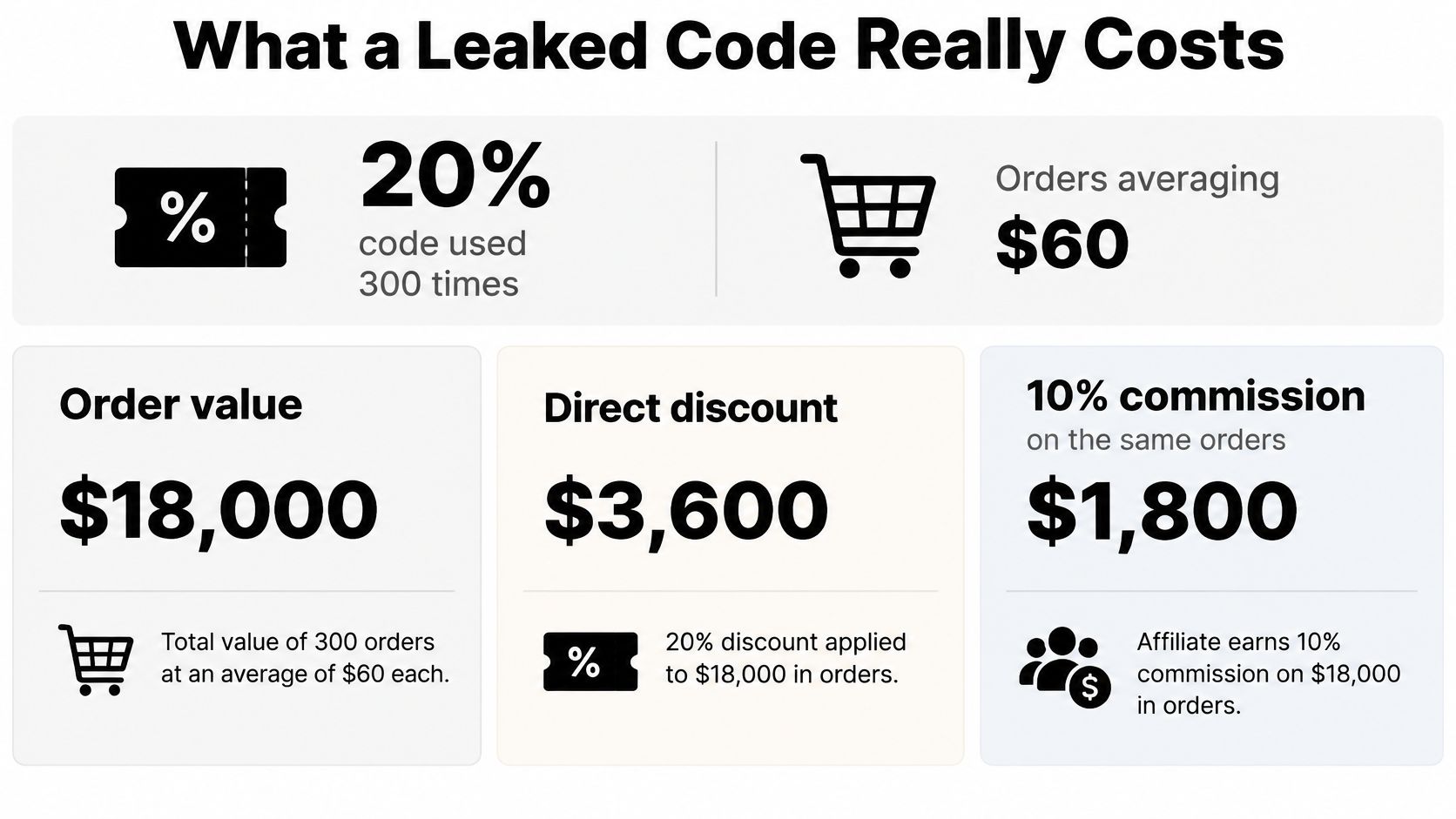
Now add the second cost. If those same orders carried a creator's code through an affiliate program paying 10%, the commission on $18,000 is $1,800, and a meaningful share of it went to someone whose audience never placed the order. You paid a marketer for demand they didn't generate.
Three more lines belong in the total. Fulfilment and shipping on orders that arrived at near-zero margin. Support tickets from shoppers whose code failed and who now think your store is broken. And the quiet one, a campaign report that overstates demand from discount-sensitive buyers, so next quarter's budget doubles down on a promotion that was really just a public listing.
The pattern is widespread. The Merchant Risk Council's 2024 fraud reporting, as summarized by industry coverage, found that 63% of approximately 1,100 merchants observed an increase in first-party misuse during the previous year, while 45% identified it as a major operational challenge (Signifyd's analysis of promo code abuse). First-party misuse means abuse by legitimate shoppers rather than external payment fraud, and a leaked code redeemed by unrestricted buyers fits the definition exactly.
A leak also compounds when the code can be combined with a live site-wide sale, which is the core problem in this explainer on coupon stacking: two legitimate offers stacked turn a mild discount into a margin wipeout.
Keep the national numbers in perspective. One industry estimate puts annual U.S. promotional and discount abuse at roughly $89 billion, though that figure spans referral, loyalty, account and coupon abuse and isn't the loss from leaked codes alone. Traditional coupon fraud is a narrower band, roughly $300 million to $600 million a year (Voucherify's coupon fraud analysis). Useful context, not a forecast for your store.
The decision that follows is simple even when the number isn't. Compare the store-level cost of the leaked code, the $3,600 discount plus the misplaced $1,800 commission plus the rest, against the cost of replacing the offer for the shoppers who were eligible. When the leak costs more than the replacement, retire it.
How to Contain a Leaked Code in Six Steps
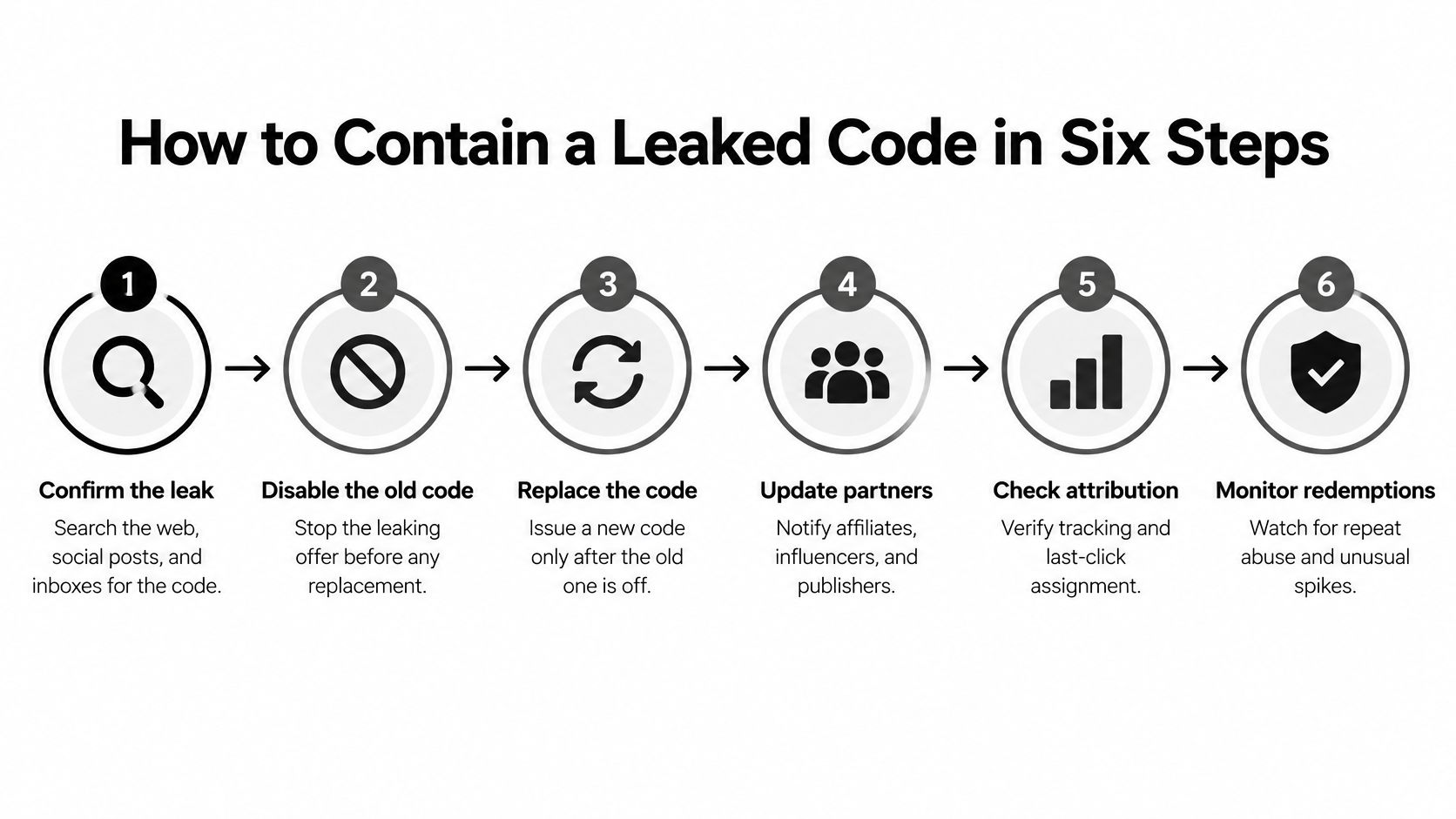
Most merchants get this wrong in the first move: they create a replacement code before disabling the old one, so the leak keeps spending while the fix circulates. Sequence beats effort here.
The framing that makes all six steps work is treating the code as an authorization token rather than a secret string. Bind eligibility to customer identity, landing link, geography or order conditions; enforce single-use or a redemption cap; and record issuance, exposure, redemption, affiliate clicks and refunds in one place. Academic pricing research found that coupon-aggregation sites disrupt price discrimination by sorting consumers on technical ability rather than willingness to pay, and industry evidence describes coupons being copied for discounted purchases and resold at a higher price (ScienceDirect research on coupon aggregation). A leaked offer becomes an arbitrage mechanism, not a promotion.
Confirm the leak with evidence. Search the exact code string on coupon sites, forums and deal groups, and log every URL with the date you found it. The slip that breaks this step is acting on a hunch and retiring a code that was popular.
Build one audit trail before you change anything. Export redemptions, affiliate clicks and refunds with timestamps. Without that history you can't prove where the leak ended or defend the decision to a partner whose numbers just fell. The slip is fixing the code and losing the record.
Disable or cap the exposed code. Set a redemption limit or a hard end date so the string stops working for everyone at once. Capping beats deleting, because the redemption record survives and legitimate holders get a clean cutoff. The slip is deleting first and shredding the audit trail with it.
Issue a controlled replacement for eligible shoppers. A new code limited to the original audience, or the same offer behind a designated link, keeps the campaign alive without the leaked value. The slip is relaunching the identical string that just circulated, which sends it straight back onto the same listings.
File takedowns and chase every one. Record each request and follow it until the listing is gone. Coupon sites respond at very different speeds, and copies reappear on other domains within weeks, so repeat the search weekly for 30 days. When a leaked code is detected, KeepCart automatically contacts the coupon site on the store's behalf and keeps tracking each request until the listing comes down.
Review redemptions for 30 days by source, region and affiliate ID. This is the step that proves containment rather than assuming it. The slip is declaring victory on day two and missing the second wave.
Done test: no new redemptions on the exposed code after the cap date, and every listing you found logged as removed or expired.
Protecting Affiliate Commissions and Checkout Sales
The reflex is to block every coupon extension and call it fraud prevention. That framing is too blunt to survive contact with real data, because it lumps two different things together: an extension collecting commission on a sale it did not influence, and a shopper using a tool to find a discount on a purchase they had already decided to make. Only the first costs you money.
The attribution mechanics explain why. Coupon sites and browser extensions work as commission-per-sale channels that typically arrive after the buying decision is made. Once a creator's code circulates past its intended audience, the commission attached to it can go to whoever published or surfaced it, while the affiliate who created the demand loses the credit. That is the part a simple listing removal never fixes: the code has already transferred promotional value to everyone who redeemed it.
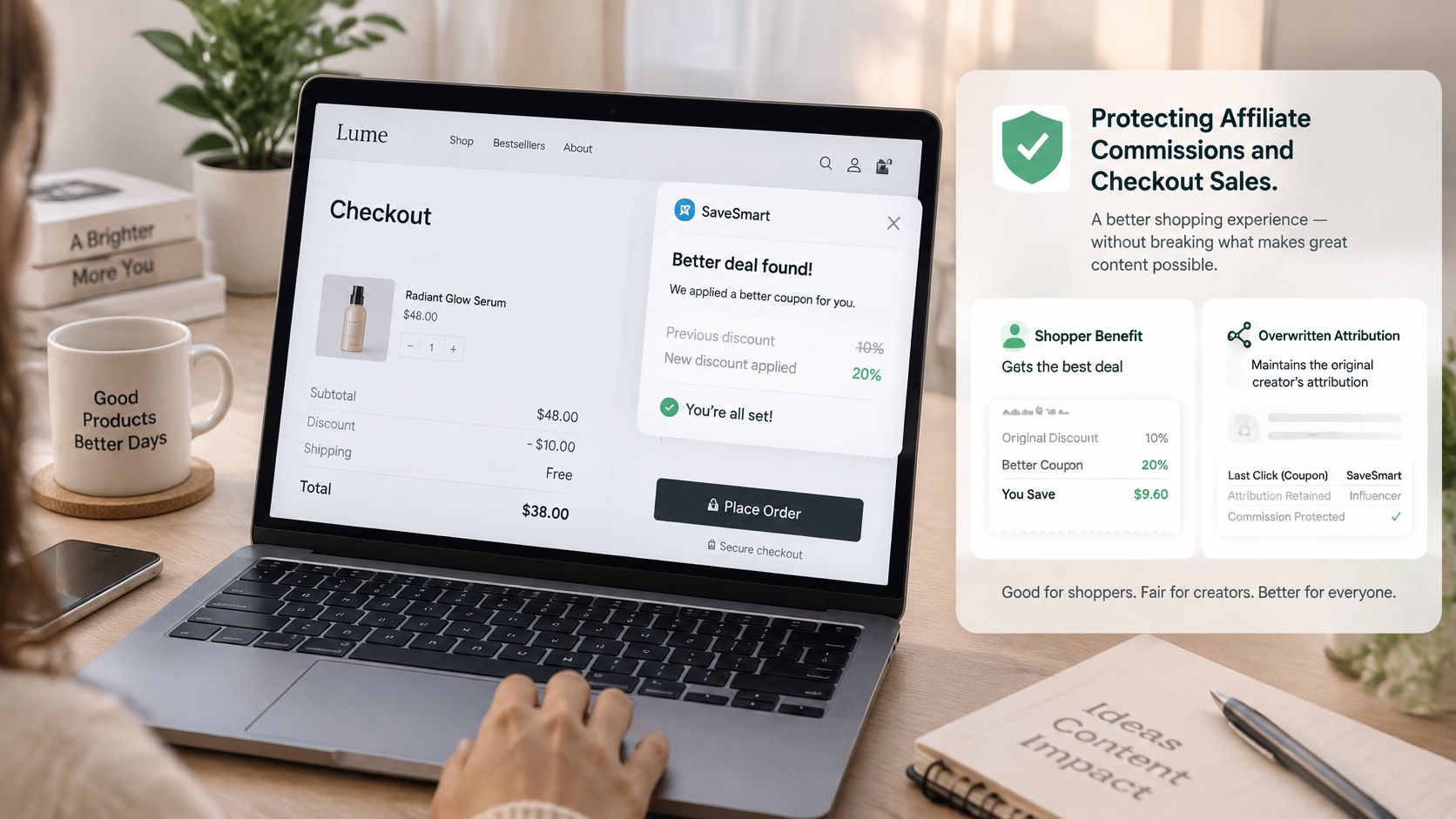
Block when an extension injects codes that have nothing to do with your campaigns, or overwrites a referral that started the journey. Preserve the sale when the tool is closing a purchase the shopper was always going to complete, and stop paying commission for the privilege. The test that settles it: compare conversion rate and order value for sessions with the extension against sessions without it, then pause the channel for a short window and watch whether sales move. Revenue holding steady means the commission was leakage. A sharp drop means you were paying for something real.
For exclusive codes, structure beats surveillance. Tie employee, influencer and partner codes to designated links so the string only redeems through the intended route, and treat any code that works standalone as a public code. This guide to influencer discount codes covers that setup.
Recovery rule: classify every rejection before you decide what to do with it, as expired, unauthorized, mistyped, region-restricted or already redeemed, then return a merchant-controlled replacement that's valid for the current cart.
Dead ends at checkout kill orders. Vanderbilt research put purchase probability at 76% among shoppers who already held a valid code, against 19% for shoppers prompted for a code who had none (Vanderbilt news release). Blocking a leaked code with no recovery path manufactures exactly that second group. KeepCart's Discount Recovery answers a failed code with a valid replacement at checkout, so the margin fix does not become a conversion problem.
Audit Your Codes Before the Next Campaign
Campaign codes are the ones most likely to travel, so the audit belongs on the calendar before the next launch, not after it. Clear a working session this week. Nothing here needs new software, and a single pass takes less time than chasing one takedown by hand.
List every active code with five fields: owner, intended audience, channel, start date, expiry date. If any line comes back with a blank owner, nobody can say whether that code should still be alive, and that is your first fix.
Flag three categories. Codes with no expiry, codes shared outside the team, and codes that are public by design. For exclusive codes, test whether the string redeems on its own. One that works without its designated link already behaves like a public code.
Set thresholds in advance. Decide what redemption volume, region mix or referrer pattern triggers a review, so the response is a rule instead of a panic. Write the threshold down next to the code's owner.
Name one person for the weekly review. A redemption review with no owner is a report nobody reads.
Threshold example: a code built for a single-market campaign that redeems across five countries gets reviewed the same day, before anyone touches the offer.
The manual pass is viable for a store with a dozen codes. Past that, the arithmetic changes. KeepCart's Detect & Manage Coupon Leaks shows which code leaked and where it surfaced, so the weekly search becomes a dashboard read. On Shopify, enter the alert email addresses in the settings section, since no address is notified by default, and the first leaked coupons land on the dashboard within an hour if any are found. When a blocked code is entered at checkout, KeepCart instantly swaps in a valid, non-fee code so the sale completes without an unintended commission. Full coupon extension blocking, leak detection and automated takedowns are included on every Shopify plan.
Choose your route: run the audit by hand with a spreadsheet and a calendar reminder, or let monitoring carry the discovery while you keep the judgement calls. Either way, book the first review date before you close the tab.
A leaked code is a margin problem and an attribution problem at the same time, and KeepCart treats it that way: it scans coupon sites and forums for exposed codes, shows you where each one surfaced, and files removal requests on your behalf while blocking the extensions that apply codes at checkout. If you'd rather watch for leaks than go looking for them, KeepCart installs on any Shopify plan and puts your first results on the dashboard.