Exclusive Discount Codes: How to Keep Them Restricted
Learn how exclusive discount codes work, why they leak to coupon sites, and how to limit them to the right audience, channel and checkout rules.
You're about to hand an influencer, a staff member, or a partner their code, and a coupon site may already have the same string. The discount still works for the people you meant. It also works for shoppers who never met that person. That defines the job of exclusive discount codes: they are an eligibility and attribution control, not a bigger percentage. A code can be valid for its intended audience and still get used in public.
What Makes a Discount Code Truly Exclusive
A creator shares a 20 percent code with followers. Within a week that same string sits on three coupon sites. Followers can still redeem it. So can anyone who copied it from a deal page. The percentage never changed. The audience did.
Exclusive means eligibility rules, not a deeper cut. The label gets used for five different setups, and each one limits a different thing.
Five ways a code can be exclusive
Single-audience code. Only one group is supposed to type it. A staff perk or a wholesale partner rate is the usual case. The secret is the text. Paste those characters into a chat and the audience rule is gone.
Protected link. Redemption is tied to a specific URL, which is common for influencer and affiliate campaigns. The code may not even be shown on the page. Forward the link and a new shopper can still check out.
Member-only code. The shopper needs an account or a loyalty membership. In 2025, 31.4% of active promo codes tracked by SimplyCodes were restricted to members, so this gate is already a common control, according to SimplyCodes. A member can still send the code to someone who never joined.
Segment rule. The order has to match a condition, such as a first purchase or a VIP tag. A shopper can probe that rule with a new email or a second account.
Higher discount only. Nothing is restricted. Anyone who has the code gets the price. Call that a public sale, even if it is called exclusive.
| Method | What It Restricts | Typical Use | Leak Risk |
|---|---|---|---|
| Single-audience code | Who can enter the code | Employee or partner discounts | Medium: the code text can be copied |
| Protected link | Where the code can be redeemed | Influencer and affiliate campaigns | Low to medium: the link can be forwarded |
| Member-only code | Who holds an account or membership | Loyalty programs | Low to medium: members can share codes |
| Segment rule | Which customers or orders qualify | First-order or VIP offers | Medium: rules can be guessed |
| Higher discount only | Nothing, so anyone can use it | Public sales | High: treated as a public offer |
A copied audience code, a forwarded link, and a shared member code fail in different places. Sort every live code into one of these rows before you change a setting. The control you need depends on whether you are limiting who may type the code, where it can be redeemed, or which customers and orders qualify.
Practical rule: If the only difference from your public offer is a bigger percentage, you don't have an exclusive code.
Where Exclusive Codes Leak and Why It Happens
Say your 15 percent employee code shows up on a deal site within a few days. Nobody had to "hack" checkout. Someone pasted it where a crawler, a forum, or a browser tool could read it. Codes spread along predictable routes.
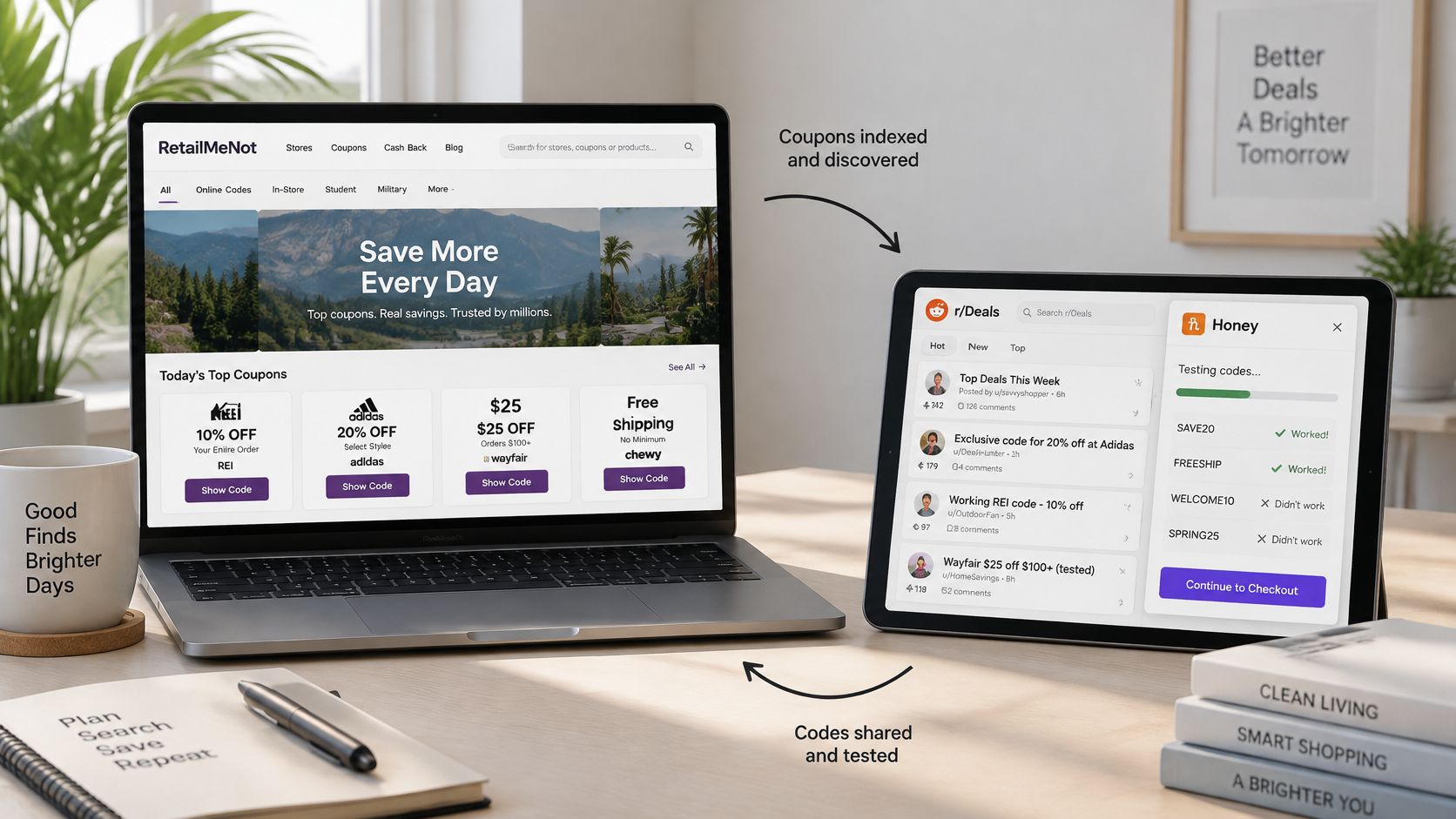
The routes that make a private code public
Coupon sites and deal forums. Once a code is posted, aggregators index the text. A newsletter blurb or a Reddit comment is enough for the string to become searchable next to your brand name.
Browser extensions. Tools such as Honey and RetailMeNot try stored codes against the cart. A code that was meant for one partner gets tested on shoppers who never clicked that partner's link.
People and files. Employees drop codes into group chats. Partners reprint them in their own newsletters. Finance and agency teams keep the same strings in shared spreadsheets, and those files get forwarded.
Discount hunting isn't a niche habit. In 2025, 91% of U.S. adults said they regularly sought coupons or discount codes online or in stores, according to a Savings.com survey of more than 1,000 adults. When that many people are looking, a searchable string will be tried.
Three questions before you change the code
Answer these before you deactivate anything.
- First publication: Where did the text appear first, your email, a creator post, a staff chat, or a partner page?
- Channel reached: Did it land on a coupon site, a forum, an extension database, or all three?
- Audience match: Are the orders from the region, customer type, and products you intended?
During a live campaign, search the code text plus your brand name on coupon sites and deal forums once a week. Write down the URL and the date. Knowing where a code appears is the first control you have. Settings come after that map, not before it.
Shopify Settings That Control When a Code Works
Shopify lets you decide when a discount code works, and for which cart. These settings don't hide the text. They stop a leaked copy from outliving the rules you set. Shopify's discount code guide covers active dates, a maximum number of uses, a minimum order value, eligible products, collections, or variants, and whether the code can combine with other discounts. The Sales by discount report shows redemptions instead of hearsay.
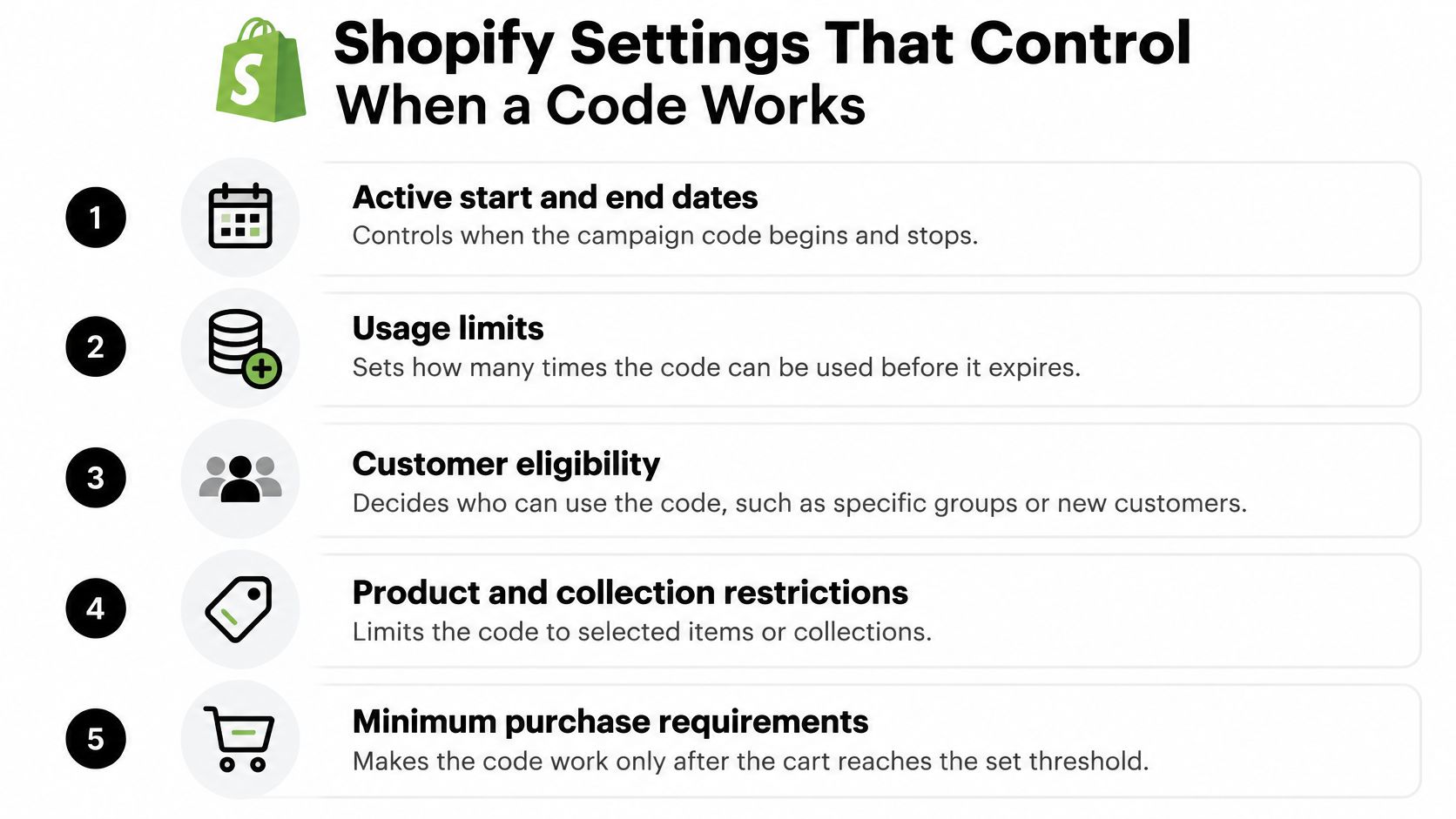
Set each control with one concrete case
- Active start and end dates. A campaign code should die when the campaign dies. Give a creator code a 14-day window that matches the post schedule, so a screenshot from last season can't keep discounting.
- Maximum number of uses. Cap total exposure. A single-use employee code with a 30-day window can't be shared across a whole office without burning the allowance.
- Minimum order value. Protect margin on small baskets. If a 15 percent partner code only clears your margin above $75, set that floor before you send the link.
- Eligible products, collections, or variants. Keep an influencer code on the line it was meant to promote. A serum code shouldn't also cut your accessories.
- Combination rules. Stop the code from stacking with a sitewide sale or an automatic shipping discount. One leak plus a stack is how a modest perk becomes a loss.
- Sales by discount. Check real redemptions weekly while the code is active. A narrow audience that suddenly burns a large share of its usage cap is a leak signal, not a success story.
Set the end date and the usage cap before you publish. A leaked code can still be used inside those rules. Dates and caps limit damage. They don't restore privacy.
Draft orders and invoice links
Draft-order checkout is a separate hole. By default, customers can't apply discount codes to draft-order invoices or checkout links, but you can turn that option on for each draft. Shopify's draft-order discount notes warn that both you and the customer may apply discounts, so the order can shrink more than you planned. If a discount on an open draft becomes invalid before completion, the order can't be completed until that code is removed. Review open drafts before you send the invoice.
How Leaks Distort Attribution and Commissions
An influencer code is supposed to pay for a sale that influencer caused. Post that code on a coupon site and a shopper can apply it after a deal page, with no visit to the creator. Under last-click attribution, the final coupon or deal touchpoint can take the credit. The partner then earns a commission on an order they didn't influence.
Walk a simple case. A creator's link logged 35 clicks. The code then shows 400 redemptions, almost all in one country outside that creator's audience, on a single afternoon. Those orders may be real. The influence claim is not. Pause the code, export the orders, and compare before you approve the invoice.
What to line up before you pay
Compare code redemptions with attributed clicks, and then with customer identity (new or returning), geography, time, and order value. A healthy partner code roughly tracks clicks, sits in that partner's market, and doesn't spike on a random Tuesday.
Watch for three patterns:
- Redemptions far above clicks. Hundreds of uses against a thin click count means the code is traveling without the partner.
- Orders outside the partner's market. A US creator code clustering in another region is a distribution problem, not a breakout.
- A one-day spike. A sudden pile of orders, especially at similar values, usually follows a forum post or an extension refresh.
Decide the pause rule before the argument. Example: deactivate if redemptions exceed attributed clicks by a set multiple, or if most orders sit outside the partner's country. Commission disputes get settled with that evidence, not with opinions.
What Shoppers See When an Exclusive Code Fails
A failed code isn't one error. Shopify's discount FAQ separates a code that doesn't exist or is no longer active, a code that exists but doesn't fit the cart, and a usage hold while payment is in progress. Each one needs a different reply. Don't reveal the partner or employee string in the message.
| Failure State | What the Shopper Sees | Usual Cause | Merchant Response |
|---|---|---|---|
| Code missing or no longer active | Enter a valid discount code. | Expired, deleted or mistyped code | Show a controlled fallback offer |
| Code valid but not applicable to the cart | Item-eligibility error | Product, collection or variant rule not met | Explain which items qualify |
| Code held during payment | No error shown, the code stays held | Payment pending or in progress | Release the hold on a declined payment and allow a retry |
Checkout shows "Enter a valid discount code." when the code is missing or inactive. An item-eligibility error means the code is real but the cart doesn't match. On submit, Shopify holds the code against its usage limit until payment succeeds or fails, and a declined payment releases that hold. An expired, ineligible, or briefly consumed code can stall checkout even when your rules are working.
What you offer instead
Pick one fallback and stick to it.
- Free shipping: Rarely gets copied the way a percent-off code does. It won't rescue a shopper who wanted a large percent off.
- Capped public offer: A small, published discount saves the order. It also trains people to hunt, so keep the cap tight.
- One-time replacement code: Protects margin if it has its own date, use limit, and audience. A replacement with no cap is a second leak.
- No discount: Protects margin and affiliate fees. You may lose the shopper who only stayed for a deal.
A code can look broken and still be correct. A rule tied to one market, one currency, or one minimum order will fail for a shopper in another region. Say which condition missed, in plain language.
The field itself pulls people off the purchase. In a controlled Vanderbilt study with 206 participants, the purchase-completion probability was 76% for participants who had a promotion code, versus 19% for participants who were prompted for a code but did not have one (Vanderbilt University). Show the field when a code arrives through a protected link, not on every cart.
How to Test Whether an Exclusive Code Adds Orders
Exclusive doesn't mean incremental. A unique string can still discount shoppers who were going to buy at full price. A 2025 analysis of more than 900,000 influencer codes found that the average influencer discount fell from 19.1% in 2022 to 15.0% in 2025, and in four of seven major categories a standard promotional code matched or exceeded the supposedly exclusive influencer offer (SimplyCodes).
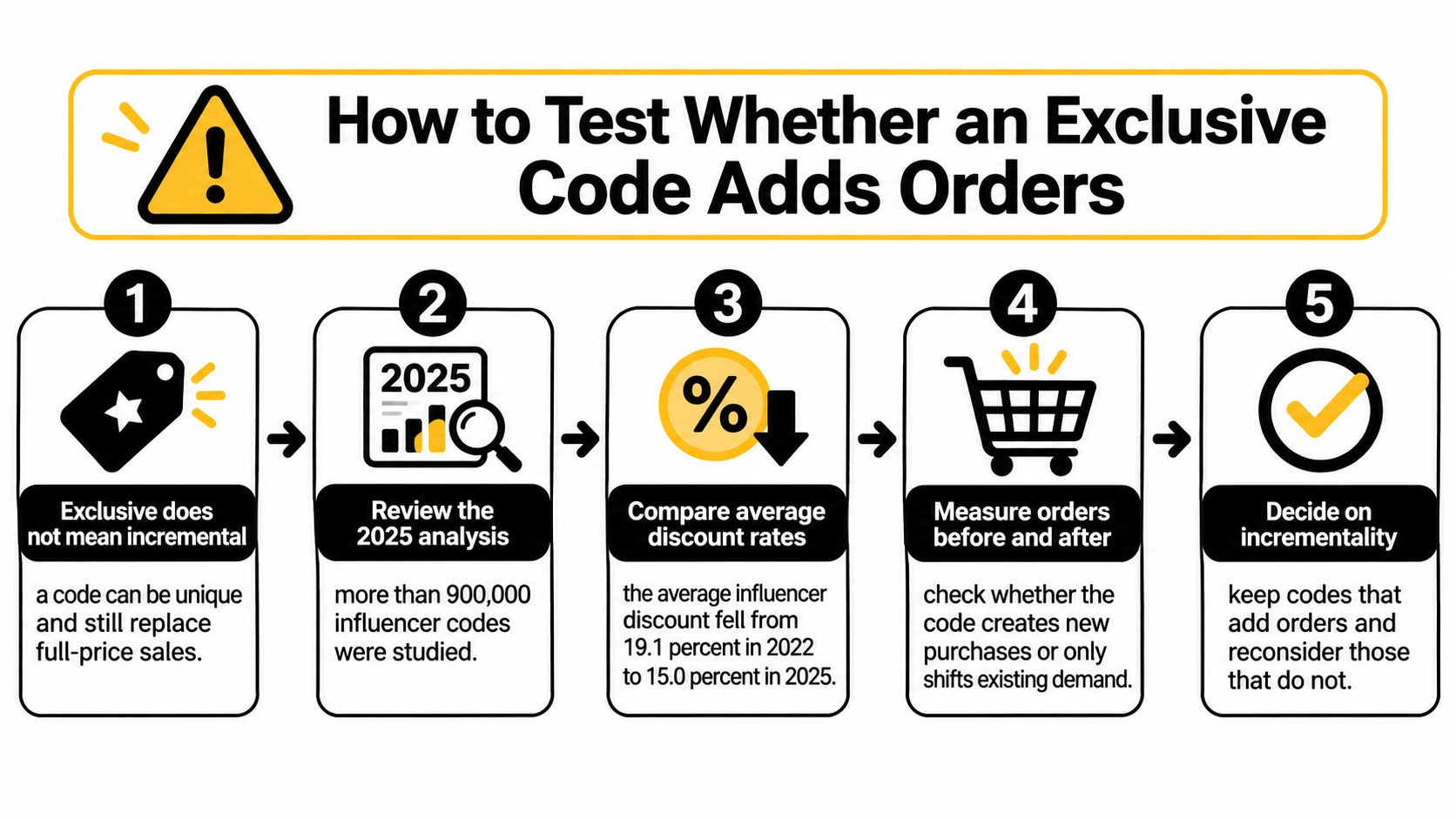
Run one code against a holdout
- Pick one code and at least two weeks. You need a clean window so a launch day doesn't masquerade as lift. Don't compare a holiday week with an ordinary week.
- Hold out part of the audience. Split eligible shoppers, or run the code in one region and withhold it in a similar region. Turning the code on for everyone leaves you with no baseline.
- Separate new and returning customers. Returning buyers often convert without a perk. Counting them as "wins" inflates the code.
- Tag affiliate and extension orders. Count orders with and without an affiliate click or a coupon-extension touch. Those orders may be reattributed demand, not new demand.
- Measure margin after discount and commission. Order volume can rise while profit falls. Ignoring the fee makes a leaking code look successful.
- Keep, shrink, or retire on incremental margin. If the holdout buys at a similar rate, shrink the percent or end the code. Don't keep it because the redemption count looks busy.
A useful result is specific. The exposed group places more orders than the holdout, the extra orders are mostly new customers, and margin after the discount and any commission is still healthy. Anything short of that is a relabeled full-price sale.
Lock Down Your Exclusive Codes This Week
Audit every active code this week and tag it by method: audience text, protected link, member gate, segment rule, or an unrestricted higher discount. Then put one control on each code. Use a protected link for influencer and partner codes. Use a single-use or member-only rule for employee codes. Put an end date and a usage cap on every campaign code.
Only the codes you approved should reach checkout, and nothing should be auto-applied, so each discount stays a decision you made. When a code fails, a recovery offer you defined can keep the sale without handing out the partner string.
Coupon protection software can run the repetitive parts. KeepCart gives you Protected Links so employee, influencer, and partner codes redeem only through the designated link, Discount Recovery that shows a valid recovery code when a shopper enters an expired or fake code, and leak detection with removal requests when a code surfaces on coupon sites.
Finish with a short list: the code, the owner, and the date you'll first read the redemption report.
KeepCart is coupon protection for Shopify stores that need exclusive discount codes to stay with the people they were issued to. Protected Links, leak monitoring, and a controlled recovery offer at checkout keep eligibility, margin, and attribution in your hands. Visit KeepCart to see how those controls fit your influencer, employee, and partner programs.
Prepared with Outrank