Employee Discount Program: How to Run One Without Leaks
Learn how an employee discount program is structured, who qualifies, and how to stop leaked codes, hidden margin loss and attribution errors.
Your staff discount code went out in a Tuesday newsletter. By Thursday it's indexed on a coupon site, a browser extension is applying it for shoppers who have never worked for you, and nobody can tell you what it cost. That's the part of an employee discount program that never makes the benefits slide.
The demand side isn't the problem. A 2025 Australian survey of 1,500 employees found 90% were affected by cost-of-living pressures and 61% wanted employers to do more, and respondents favored discounts or subsidies for essentials like utilities, insurance and healthcare over less practical lifestyle perks (HRM Online report on the Origin Zero survey). Staff want the savings. Brands want the loyalty.
What fails is distribution. A discount built for 400 people is one copy-paste away from serving 40,000, and the checkout usually can't tell the difference.
What an Employee Discount Program Actually Is
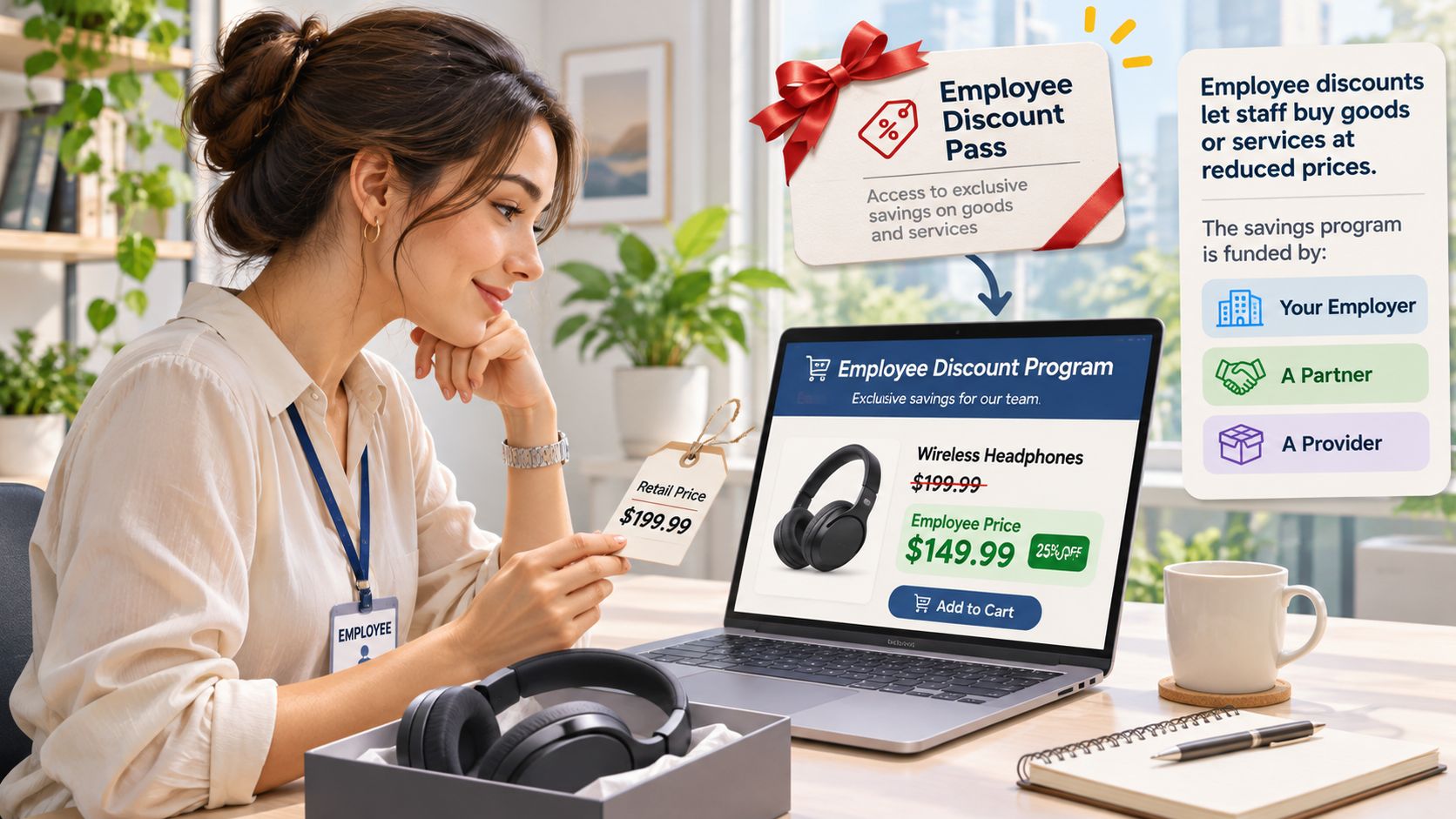
An employee discount program lets staff buy goods or services at a reduced price, with someone else absorbing the difference: their employer, a partner brand, or a provider that negotiates rates across a merchant network. Picture the staff-only back room in an old department store. The discount is the key. The program decides who gets a key, which doors it opens, and when the key stops working.
This is a mainstream workplace benefit, not a niche perk. The Society for Human Resource Management's 2012 survey found 58% of responding organizations offered one, and size decided almost everything: 94% of employers with at least 25,000 employees ran a program, against 19% of employers with fewer than 100. The same survey found 32% of HR respondents reporting that between 1% and 25% of employees used the program, while 55% of HR professionals said employees valued the discounts "highly" or "somewhat."
Large companies run programs easily because benefits administration is centralized and the product catalog is wide enough to make discounts worth operating. A merchant with three product lines has none of that advantage.
Enrollment isn't use
Availability is not adoption, and the gap between the two numbers above tells you where the work is. Staff like the benefit. Most of them don't touch it. Communication, eligibility rules, discount depth and redemption friction decide the rest.
That gap is also where the operational risk lives. A program designed for a defined workforce carries a much larger potential audience the moment codes circulate outside it, and every extra redeemer is margin you didn't budget for.
Working definition: An employee discount program is a controlled distribution channel. It has an eligible population, a funding source, redemption rules, and a measurement layer.
Three questions decide whether yours works: how the program is structured, how the offer reaches the people entitled to it, and how you control and measure what happens at checkout.
Four Program Models and Who Pays for Each
Most programs fail in the same place. Nobody wrote down who funds the discount and who checks eligibility. Here are the four models you'll meet, mapped to the control each one needs.
| Model | How the employee buys | Who funds the discount | Control it requires |
|---|---|---|---|
| Employer retail staff discount | Staff buy from the company's own store at a set percentage off | Employer absorbs the margin | Staff ID checked at point of sale |
| Third-party discount portal | Employee logs in on the provider site and pays from their own bank account | Provider or employer subsidy | Verified login, single-use or tokenized links, redemption limits |
| Payroll-linked voluntary benefit | Purchase deducted from salary or made through salary sacrifice | Employee and employer share cost, depending on scheme | Employee-status feed, audit trail, country tax treatment |
| Brand-issued partner or staff code | Eligible person enters a code or uses a designated link at checkout | Brand funds the discount | Protected links, expiry dates, leak monitoring |
Employer retail staff discount. The employer eats the margin and the checkout is a person. This model is common because retail staff are surrounded by the products they sell, and the card has to be shown at the till. It shows up most in retail: a 2015 Joseph Rowntree Foundation report based on a Survation survey found 73% of low-income employees in retail received an employee discount, and approximately 76% of low-income retail workers reported getting one on their employer's own products. The weak point is the physical check. Once the same benefit moves online, the ID check disappears and the code takes its place.
Third-party discount portal. The employee logs in on the provider's site and pays from their own bank account. Somebody else negotiated the rates, and the control you lose first is identity. A portal that hands every employee the same login code gives you no way to tell a redeemer from a stranger.
What changes when payroll is involved
CIPD's survey of 280 reward professionals draws a line that matters technically. Among employers offering choice, 73% provided discount benefits, 61% provided voluntary benefits and 45% flexible benefits. CIPD defines discount benefits as informal arrangements where employees purchase from their own bank account, while voluntary benefits are formal, usually provider-arranged, and bought through payroll or salary sacrifice.
That difference changes your build. A bank-account model needs identity verification, tokenized or single-use links, redemption limits and post-transaction reconciliation. A payroll-linked model needs all of that plus dependable employee-status feeds, deductions or eligibility synchronization, audit trails and country-specific tax treatment.
Brand-issued partner or staff code is the cheapest to launch and the easiest to leak, because the checkout is the entire control surface. There's no till, no portal login and no payroll record, just a field that accepts a string.
Cross-border employers shouldn't assume a single percentage carries uniform value or compliance treatment. Currencies, VAT rules, employment status and local benefit-tax rules all differ, so store the employee's market, currency, employment eligibility, offer version and redemption timestamp, and block reuse after termination or expiration.
Rule of thumb: the more the employer controls who buys and how, the more tracking the program needs. A till check needs a rota. A payroll benefit needs a tax opinion.
How to Launch an Employee Discount Program in Six Steps
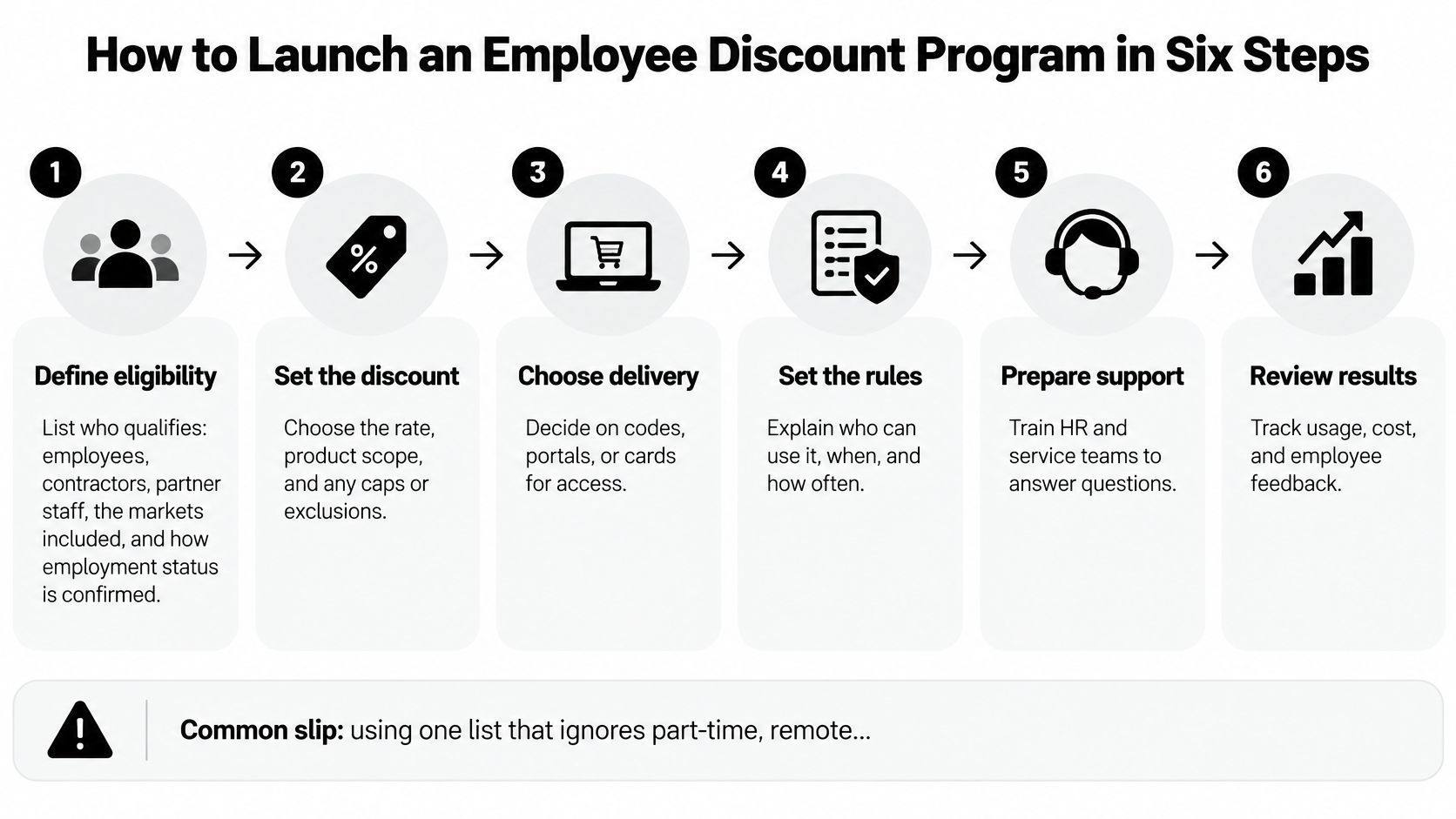
Six steps, in this order. Skip one and the program usually returns as a margin problem inside a quarter.
Define eligibility. Write down who qualifies (employees, contractors, partner staff), which markets are included, and how employment status gets confirmed. The usual slip is one list that ignores part-time, remote and seasonal workers, so people who should get the discount can't prove they're entitled to it.
Choose the model and the funding. Pick one row from the comparison above and decide who pays, with a monthly budget cap attached. Without a cap, one shared code can spend more in a month than the program was meant to cost in a year.
Set the offer rules. Fix the percentage, the excluded categories, a per-order limit, and whether the discount stacks with sitewide sales. Stacking with clearance pricing is the expensive mistake, because you end up discounting the stock you can least afford to mark down further.
Pick the distribution path. A unique link per person, a verified login portal, or a staff ID at the point of sale. Handing one shared code to the whole company is the version that leaks within days and can never be attributed to a person.
Build the fallback and the offboarding rules. Set expiry dates, remove leavers from eligibility automatically, and prepare a merchant-approved replacement offer for failed codes. Failure has a real cost: a conversion-rate review citing Baymard Institute's aggregation of 50 studies puts average cart abandonment at 70.22%, and reports that 46% of shoppers have left items in their cart because a discount code didn't work.
Set measurement and review. Run a 30 to 60 day pilot, report activation and margin monthly, and adjust before you widen the rollout. Judging the pilot on enrollment alone tells you who signed up, not whether the discount bought an order that wouldn't have happened anyway.
What a healthy pilot looks like
Steady activation rather than a launch-week spike. Few redeemers outside the eligible list. Discount cost that stays under the cap even in a heavy month. If any of those three is off, fix the distribution before you add more staff to the program.
Before the first code goes out: announce it in one short note that names the offer, states who qualifies and shows where to claim it. Awareness moves usage more than the headline percentage does.
Keeping Codes Out of Public Hands
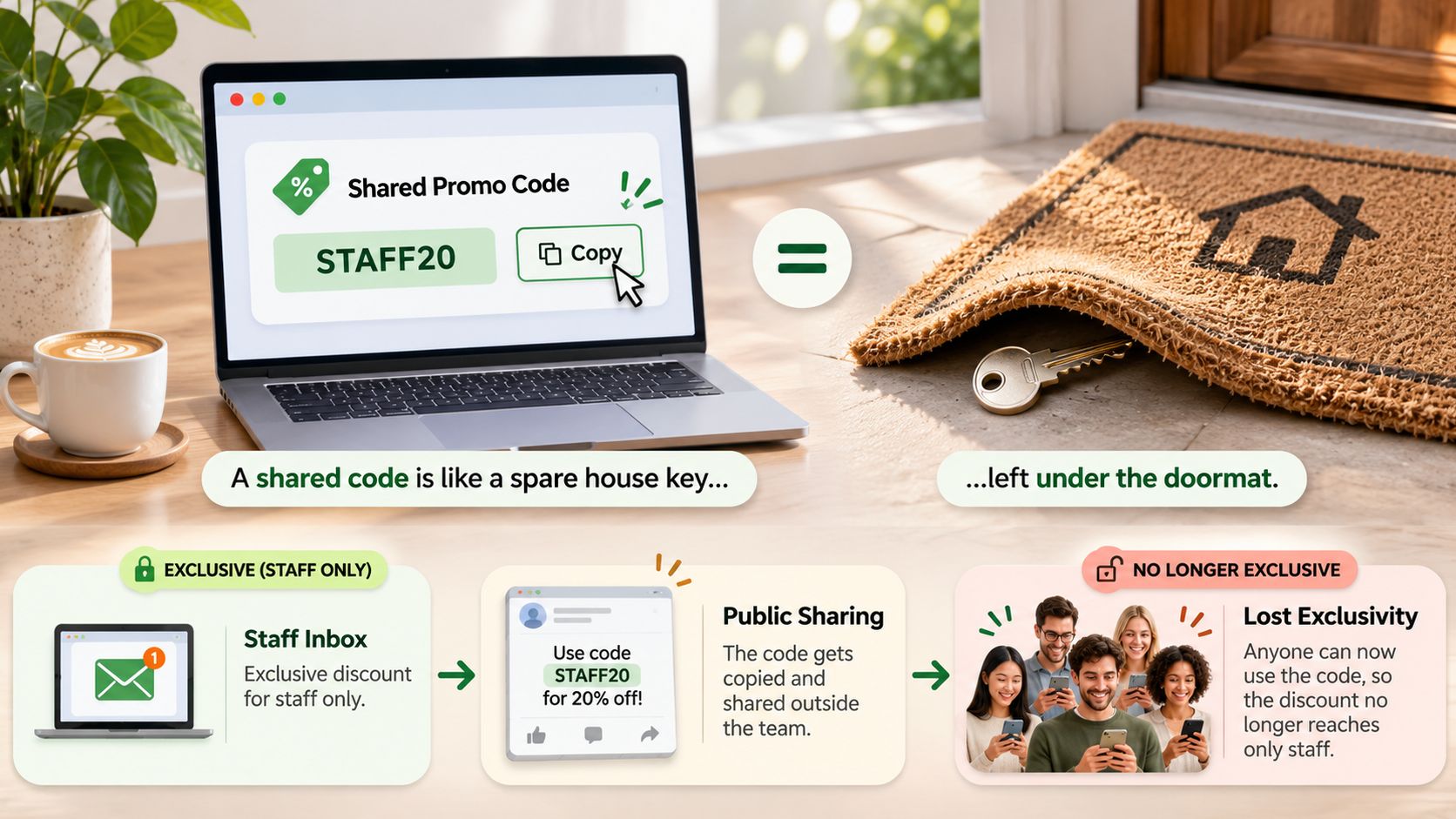
A shared employee code is a spare key under the doormat. It works exactly as intended until someone who shouldn't have it picks it up, and then you have no record of who used it.
The path is predictable. A staff member forwards the code to a group chat, a coupon site indexes it, and a browser extension starts applying it at checkout for anyone who installs the extension. Nobody has to act in bad faith. Someone trying to be helpful starts the leak.
Checkout design makes it worse. A review citing Baymard research reports that about 35% of ecommerce sites display promo-code fields by default, while PayPal and comScore research is reported as finding that roughly 27% of shoppers abandon their cart to search for voucher codes (Ecomhint's cart abandonment guide). An empty promo field tells every visitor a discount might exist, including the ones who aren't eligible for yours. They leave, find a leaked code, and come back with it.
Controls in order of effort
- Give each person a unique code or link. A per-person code carries eligibility into checkout, so you can protect your discount links rather than publishing a string anyone can copy. This is the single highest-value change and it costs you an afternoon of setup.
- Keep the employee code out of the public promotion field. The offer should arrive through the link, not through a banner that invites everyone to type something.
- Monitor coupon sites and forums. Set a recurring check for your code patterns, and file takedown requests when a listing appears. Speed matters more than volume here, because a listing indexed for a week gets scraped by aggregators.
- Block extension-injected codes. Software built for Shopify stores can reject a code injected by a browser extension before it reaches the checkout field, then substitute a valid code that doesn't trigger an affiliate fee.
When a code leaks anyway
Work the sequence rather than improvising it. Identify which code leaked and where it surfaced. Retire that code immediately. Notify eligible staff with the reason in one line, not a paragraph. Issue replacement links the same day. Then log the takedown request and its status, so the next leak doesn't start from zero.
The instinct to leave a leaked code live "until month end" is what turns a small exposure into a quarter of unplanned discounting.
Where Employee Discounts Quietly Lose Money
The headline percentage is the smallest cost in the program. The bills arrive later, from the same code doing things you never authorized, ranked below by what they cost beyond the discount itself.
Browser extension injection comes first because it charges you twice. An extension injects a partner or employee code at checkout after the shopper already arrived through another channel, and the sale gets credited to an affiliate that generated none of the demand. Industry reporting describes this as a last-touch problem, and one industry estimate puts coupon-extension attribution hijacking at 4% to 9% of coupon-attributed conversions, varying by sector and measurement method (Mate's review of affiliate marketing industry changes). Treat that range as an estimate rather than a benchmark. The mechanism is what matters: you pay the discount and the commission on the same order.
| Leak | How it happens | Hidden cost | Fix |
|---|---|---|---|
| Code posted on coupon sites | Staff share the code publicly or it is scraped | Unlimited use by shoppers outside the program | Unique or protected links, leak monitoring and takedowns |
| Browser extension injection | Coupon tool applies the code at checkout | Affiliate commission on sales the partner did not drive | Block injected codes and substitute a non-fee code |
| Ex-employee reuse | Code stays active after the person leaves | Discounts for people no longer on payroll | Sync terminations and expire codes automatically |
| Stacking with other promotions | Employee code combined with a sitewide sale | Margin lost on items already discounted | Exclude sale items and set a stacking rule |
| Tax misclassification | Benefit treated as untaxed where local rules tax it | Compliance exposure and unexpected cost to staff | Check local benefit-in-kind rules with payroll or tax advisers |
Three rows worth a second look
Ex-employee reuse is the quiet one. Nobody reports it. A code issued to someone who left eight months ago still works, still discounts, and never appears in a termination checklist. The fix is mechanical: connect your eligibility list to whatever system knows who has left, and expire codes on the termination date rather than at the end of the quarter.
Stacking drains margin fastest. If an employee code applies on top of a sitewide sale, you're discounting goods already marked down to move. Understanding what coupon stacking does to your margin is worth an hour before you publish terms, because the fix is a one-line exclusion, not a rebuild.
Tax treatment changes the true value of the benefit on both sides. In Germany, employee discounts can be taxable benefits in kind, though the rules include a valuation reduction and an annual tax-free allowance for qualifying discounts on the employer's own goods. Confirm the current thresholds with a local tax adviser before setting terms, because what an employee keeps after tax and eligibility limits is rarely the number printed on the offer.
Triage question: which of these leaks is costing you most this month, and which fix can you ship by Friday? Start with the one that touches money you can already see.
Measuring and Piloting One Model Before You Scale
Programs get approved on enrollment and cancelled on margin. The numbers that settle the argument sit between those two.
Large employers already treat discounts as a benefits channel. In EBRI's survey of 250 large employers interested in financial-wellness initiatives, employee discount programs covering categories such as mobile phones, travel and entertainment were offered by 72% of respondents, the highest prevalence among the listed benefits, ahead of tuition reimbursement at 69% and financial-planning education at 60%. The same research notes that employers often lacked metrics for evaluating these initiatives, which is the gap worth closing first.
| Metric | What it tells you | Warning sign |
|---|---|---|
| Eligible employees | Size of the audience the offer is meant for | Eligible list is out of date after hiring or leaving |
| Activated users | Staff who created an account or claimed a link | Low activation points to poor communication, not weak demand |
| Unique redeemers | How many people actually used the offer | Redemptions from people outside the eligible list |
| Redemption frequency | How often each redeemer buys | One person driving most redemptions, which often signals sharing |
| Average discount value | Cost of each discounted order | Discount value rising faster than order value |
| Incremental order rate | Orders that would not have happened without the program | No holdout group, so the rate cannot be measured |
| Gross-margin impact | Net financial effect after discounts and fulfilment | Margin falling even as order counts rise |
Why incremental orders need a holdout group
Incremental orders are sales that wouldn't have happened without the program. You can't see them in a redemption report, because the report only shows you people who used a code, not what they'd have done without one.
Set aside a holdout group of eligible staff who receive no code for the test period, then compare order rates. The arithmetic is blunt: an $80 order at 15% off costs $12 in discount. If that order would have happened anyway, the program spent $12 and gained no sale. If the holdout group buys at nearly the same rate, the discount is subsidizing existing demand.
Watch for one person driving most redemptions. That pattern usually means a code has been shared, not that you've found your best customer. When it shows up, trace the discount code leak to its source before you touch the offer terms.
The 30-day pilot
Don't launch every model at once. Pick one model from the comparison, set eligibility and a monthly budget cap before issuing any code, and give unique links to one group while holding the rest back. Review the numbers weekly rather than at the end, so a bad cap gets corrected while the pilot is still cheap.
At day 30, make one call: scale it, adjust the terms, or stop. For Shopify brands, KeepCart's Protected Links lock exclusive employee codes to designated links, so the code is redeemable only through that link, and only the codes you approved reach checkout with nothing auto-applied.
One monthly page, seven numbers, one decision. That's a program you can defend in a budget meeting.
KeepCart is coupon protection built for Shopify stores: it blocks more than 120 coupon extensions before they reach checkout, monitors coupon sites for leaked codes, and files takedown requests with the sites that list them. Protected Links keep exclusive employee codes redeemable only through the link you issued, and Discount Recovery hands a shopper a merchant-approved replacement when a code fails instead of losing the sale. Visit KeepCart to see how it fits the way your store discounts today.