Direct and Indirect Competition: Who Really Competes?
Learn the difference between direct and indirect competition, how to identify each rival type, and how to assess which threats hit your margins most.

You're checking competitors' sale prices before your next promotion, but your own checkout tells a stranger story. Orders are coming in, shoppers are using codes you didn't advertise, and affiliate commissions don't always match the partners who brought customers to your store. Matching another brand's discount won't necessarily fix that.
Understanding direct and indirect competition means looking beyond businesses that resemble yours. You need to know what customers choose instead, what consumes the same budget, and which intermediaries change the economics of a sale you've already earned.
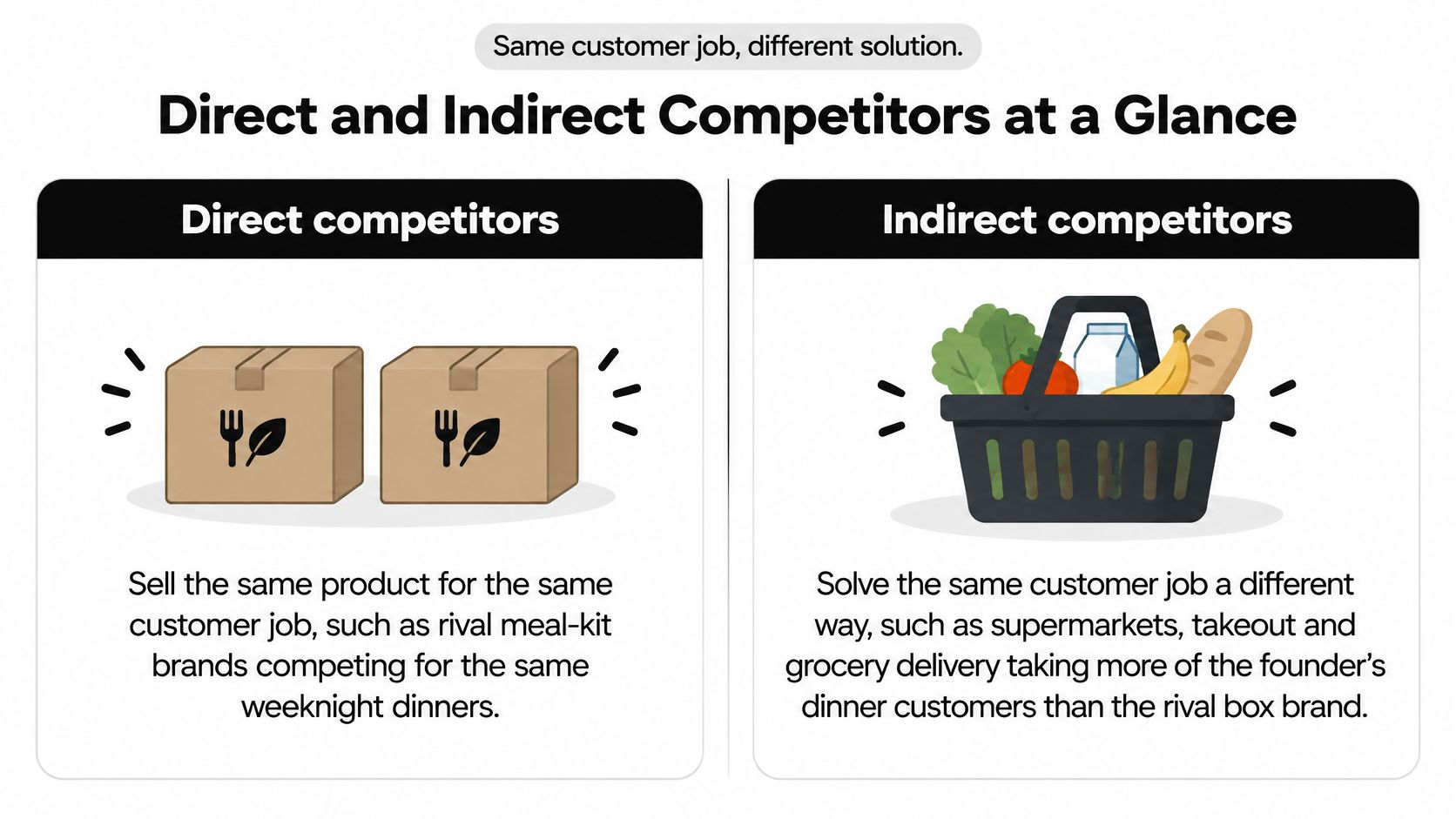
Direct and Indirect Competitors at a Glance
Say a meal-kit founder checks rival websites every Monday. She compares recipes, delivery options, and introductory offers, then discovers that customers who cancel aren't buying another box. They're collecting supermarket ingredients on the way home.
Her competitor list wasn't wrong. It was incomplete.
Direct competition means selling closely comparable products or services to the same customers. Indirect competition means satisfying the same underlying need through a different product or process.
Direct vs indirect competitors side by side
| Competitor type | Core question | Typical rivals | Meal-kit example |
|---|---|---|---|
| Direct | Does it sell the same thing to the same buyer? | Other companies with comparable products | Rival weekly recipe box at a similar price |
| Indirect | Does it solve the same problem differently? | Substitute products and channels | Supermarket ingredients and ready-made meals |
| Budget substitute | Does it take the same spending away? | Doing nothing or cheaper alternatives | Cooking from pantry staples or skipping dinner planning |
The distinction becomes clearer when you compare the customer's choices side by side.
Customers Choose Outcomes, Not Categories
The rival recipe box offers a similar buying experience. Supermarket ingredients require more planning, but they can still deliver dinner. Pantry staples may require no new purchase at all, which makes them easy to overlook in conventional market research.
Budget substitutes are a useful planning subgroup, not a completely separate economic universe. They help you remember that customers can postpone spending, improvise, or tolerate a problem rather than purchase any commercial solution.
There's also a terminology trap. Economists distinguish between direct and indirect measures of competition, which isn't the same distinction as direct and indirect competitors. Statistics Canada's analysis of competition measures treats firm mobility as a direct measure and market structure as an indirect proxy, illustrating why a structural snapshot alone doesn't describe every competitive pressure.
For the founder, a list of recipe-box brands describes her category. A list that includes supermarkets, restaurants, and improvised dinners describes her customers' actual choices.
Practical rule: Put comparable sellers and alternative solutions in separate columns before deciding who deserves a response.
Don't assume the most recognizable rival is the most important one. First establish where customers go when they don't choose you.
The Core Idea Is the Customer's Job
A cinema and a streaming service look like different businesses. One sells tickets and an outing; the other offers viewing at home. Yet both can compete for a relaxing Friday evening.
The setting changes, but the customer's intended outcome connects the alternatives.

Use the Customer-Job Test
- Write the outcome in one sentence. Try “enjoy a relaxing Friday evening” or “stop promotions from eroding margin.” Avoid naming your product in the sentence.
- List every plausible solution. Include commercial products, internal processes, free workarounds, and leaving the problem unresolved.
- Mark shared budget and time. Ask which alternatives the buyer would realistically weigh against each other, rather than collecting everything vaguely related.
Consider a Shopify merchant evaluating coupon protection. The job isn't owning another application. It's keeping promotional spending under control without making checkout unnecessarily difficult.
A manual coupon audit, a spreadsheet of exposed codes, platform-native restrictions, and affiliate-management procedures could all compete for that operational budget. The merchant might prefer a labor-intensive workaround because it feels familiar, even if software would change how the work gets done.
That's why unfamiliar competitors deserve attention. ProMarket's discussion of indirect entry describes successive computing-platform shifts in which new firms, rather than the dominant businesses of the previous platform, typically won the next phase.
The useful lesson isn't that every substitute will replace your category. It's that a different architecture or business model can matter before it looks like a conventional rival.
Use this video as another prompt for thinking beyond product labels.
Define competitors by the job customers need done, not by the shelf your product sits on.
That framing also improves positioning. Instead of explaining why your tool has more features, explain why its approach serves the buyer's intended outcome better than their current workaround.
How to Identify Your Direct and Indirect Rivals
Build your competitor map around buying decisions, not a collection of logos. Start with a spreadsheet that records the alternative, competitor type, customer job, discovery channel, and evidence that buyers consider it.
Keep observations separate from assumptions. A customer mentioning a substitute is stronger evidence than your team deciding that it “must be a competitor.”
Build the List Without Missing Substitutes
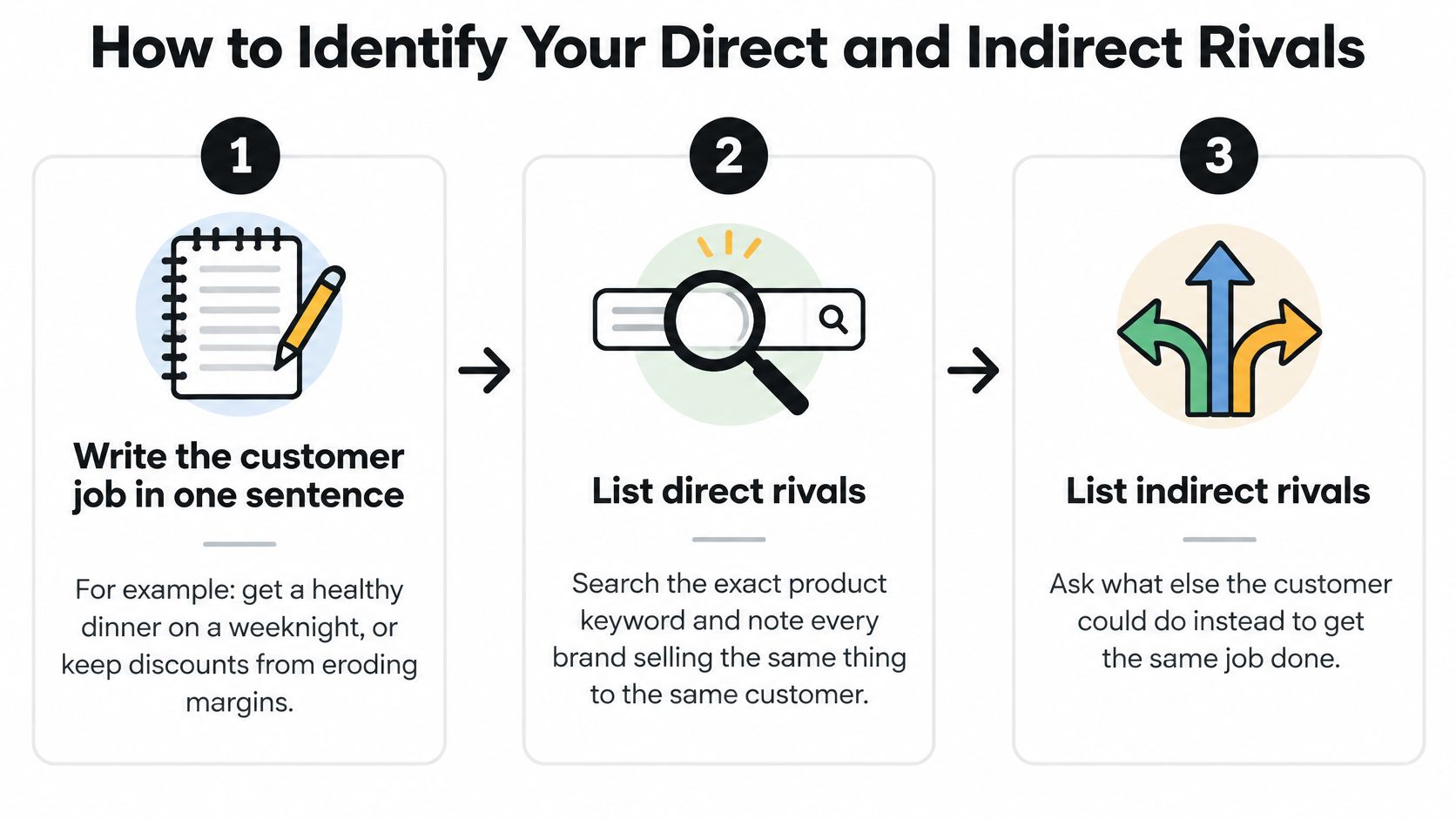
Write the customer job. Use an outcome such as “get a healthy dinner on a weeknight” or “keep discounts from eroding margins,” then check whether customers describe the need similarly. The common mistake is writing a product specification instead of a reason to buy.
Search for direct rivals. Search the exact product keyword, then inspect sellers targeting the same buyer, market, and price band, including marketplace listings and specialist directories. Stopping at the first page of search results can hide niche rivals that matter to a particular segment.
Ask what customers do instead. For dinner, consider supermarkets, delivery apps, and leftovers; for promotion control, consider manual audits, spreadsheets, and accepting the cost. The common mistake is excluding alternatives because they aren't sold as products.
The starting sequence is simple enough to use during a customer interview.
Check Where Buyers Encounter Each Alternative
Trace the discovery channels. Review search results, marketplaces, coupon sites, social feeds, affiliate networks, and customer forums, recording where each alternative appears. Don't confuse visibility in your own browsing habits with visibility among your customers.
Interview switchers and near-switchers. Ask recent buyers what they compared, what they used previously, and what nearly stopped the purchase, allowing them to name alternatives before you suggest any. Asking only satisfied long-term customers can hide the objections that cause others to leave.
Sort and cross-tag the findings. Group alternatives as direct, indirect, or budget substitutes, then flag those appearing across multiple channels and record the specific customer segment involved. The common mistake is treating a category label as permanent when the same business can compete differently across buying situations.
A usable map should contain an evidenced alternative in each relevant group and the channel where customers encounter it. If a group is empty, record it as a question to investigate rather than inventing a rival.
Add a short evidence note, such as “mentioned during cancellation” or “compared before purchase.” That gives your team something more useful than a long list of businesses everyone already recognizes.
Hidden Indirect Threats Most Comparisons Miss
Your most expensive indirect competitive pressure may come from a browser tool, not another brand. It may affect who gets paid for your sale rather than where the shopper buys.
Strictly speaking, an attribution intermediary isn't always a competitor for the customer's underlying purchase. But it belongs on your margin-threat map when it competes for commission credit or changes the discount applied.
Bloomberg testing reported by The Economic Times examined the Phia browser extension across more than 50 websites and found that it opened a background tab without user interaction during checkout and injected a referral code that could override an existing referral. The report described the behavior as cookie stuffing.
Separate Savings From Attribution
The mechanism matters: an injected identifier changes the recorded referrer, which can change commission allocation. An additional commission reduces contribution margin, while reassigned credit can make the wrong channel appear responsible for the purchase.
A checkout savings prompt doesn't, by itself, tell you whether the tool created demand.
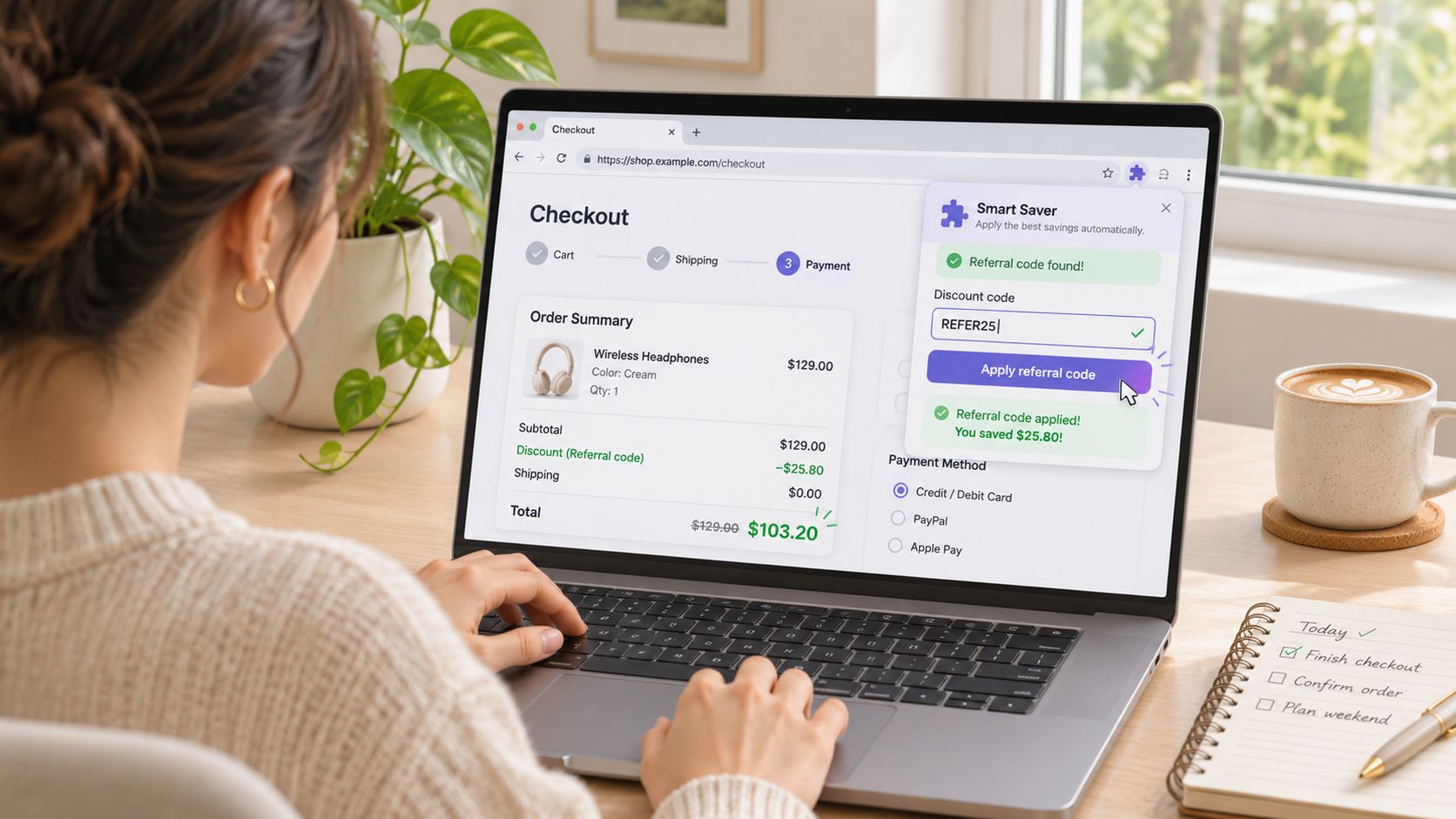
Private codes create a related problem. MediaPost's reporting on unauthorized coupon use describes deal sites and browser extensions redistributing offers intended for employees, influencers, subscribers, and other restricted audiences.
You don't need to prove who shared a code to establish that ineligible shoppers are redeeming it. Removal can remain incomplete while eligibility restrictions still protect the promotion's purpose.
Measure the Economic Difference
- Conversion rate by exposure: Compare shoppers exposed to extension activity with comparable unexposed shoppers. Control for campaign, device, customer status, and basket characteristics where possible.
- Contribution margin after discount: Subtract product costs, variable fulfillment and payment costs, discounts, and attributable commissions consistently. Don't subtract discounts twice if revenue is already net of them.
- Affiliate-assisted revenue: Compare credited orders with genuine inbound referral paths, checking whether an earlier creator or publisher introduced the shopper.
Treat observational differences as signals, not proof of incremental sales. Controlled tests provide a stronger basis for deciding whether a tool generates demand or discounts existing intent.
The APMA attribution audit found soft-click attribution effective at preventing unwanted referral-credit overwriting. Blanket blocking can also sacrifice price-sensitive demand, so assess whether transparent savings can remain available without unintended commission credit.
Use this distinction when evaluating coupon extensions: discount application and attribution behavior require separate decisions.
How to Score Each Competitor's Threat
Not every alternative deserves equal attention. A familiar brand may dominate team discussions while a less visible process, promotion, or intermediary has a greater effect on profit.
Evaluate each threat against the same criteria, but keep the supporting evidence beside the score. Otherwise, a spreadsheet can make subjective impressions look more certain than they are.
Five criteria for scoring a competitor's threat
| Criterion | High threat looks like | Low threat looks like |
|---|---|---|
| Customer overlap | Targets the same buyers and budget | Serves a different segment or occasion |
| Ease of substitution | Customers switch with one click | Switching needs setup time or cost |
| Price pressure | Rival discounts move your conversion rate | Price changes have little effect on your sales |
| Margin impact | Rival promotions force your own discount | Rival activity leaves your margins unchanged |
| Attribution exposure | Rival tools claim credit for your sales | No overlap in referral or affiliate paths |
Combine Severity With Encounter Frequency
Use a simple internal scoring convention: rate each criterion from 1 to 3, with higher ratings indicating greater threat. Add the ratings, then multiply the total by the share of comparable buyer interviews in which that alternative appears.
Priority score = total criterion ratings × buyer-mention frequency
This is a planning heuristic, not a validated industry benchmark. Use the same interview period, customer segment, and frequency definition across the alternatives you're comparing.
A rival mentioned by most buyers should receive more attention than an equally strong rival mentioned rarely. Don't mix raw search impressions with interview mentions, because those measures describe different things.
A competing meal-kit brand may score highly on customer overlap. A supermarket might score lower on overlap across its entire customer base but highly on substitution for a specific weeknight dinner occasion.
Score the occasion, not just the company. A broad retailer can become a close substitute when you narrow the decision to the job your buyer needs done.
Let Margin Override Visibility When Necessary
A low overall score doesn't automatically mean low urgency. A leaked restricted code can create a recurring cost on affected orders even if customers never mention the coupon site in an interview.
Decision check: Before approving a response, ask whether you're protecting profitable demand or merely reacting to a visible rival.
Maintain a separate financial view showing affected orders, contribution-margin differences, and confidence in the evidence. Where feasible, estimate the recoverable margin rather than treating every discounted order as avoidable loss.
Some shoppers might not have purchased without an incentive. Others would have bought anyway, which is why the counterfactual matters.
Rank threats by their likely effect on revenue and contribution margin, then choose the top three for action. Give each an owner, a response hypothesis, and a measurement plan rather than treating the ranking itself as the finished strategy.
Direct and Indirect Competition in Real Businesses
| Business | Direct rival | Indirect rival or operational pressure | Strategic question |
|---|---|---|---|
| Meal-kit brand | Another recipe-box provider | Supermarkets and restaurants | Why choose this way of getting dinner? |
| Shopify store running a sitewide promotion | A same-niche brand holding a sale | Coupon extensions and leaked codes | Which orders remain profitable after all incentives? |
| Affiliate-led brand | Other brands recruiting the same creators | Manual affiliate audits and attribution disputes | Which activities deserve credit and operating budget? |
The Shopify store faces the clearest collision. A rival's sale creates visible price pressure, while an exposed code can make the merchant's own offer cheaper than intended.
A 2024 theoretical study of platform and seller couponing found that simultaneous couponing can reduce consumers' actual payments, particularly when the platform's product has a quality advantage. That's a model-based finding, not a promise about every promotion, but it cautions against assuming overlapping discounts merely redistribute demand.
Control Eligibility Before Matching Discounts
Instead of matching a rival indiscriminately, separate code families by audience and market. Test effective checkout prices under competing promotions, including which offers can combine and which products qualify.
Measure contribution margin after discount rather than conversion alone. A controlled replacement offer may preserve a legitimate incentive without honoring an exposed restricted code.
The affiliate-led case also needs careful labeling. Manual audits aren't rival brands, and disputes aren't competitors in the conventional sense. They are operational alternatives or costs competing for the resources needed to run the program.
For a Shopify app such as KeepCart, direct rivals would be other applications offering coupon blocking, discount-leak monitoring, or automated removal requests. Indirect alternatives include manual audits, spreadsheet-based tracking, and accepting leakage costs, a distinction worth making when comparing ecommerce apps.
- Meal-kit lesson: Win the dinner occasion, not only the recipe-box comparison.
- Shopify-store lesson: Manage the final transaction economics, not only the advertised offer.
- Affiliate-brand lesson: Separate partner acquisition, operational work, and justified commission credit.
The same framework works across products and software, provided you distinguish actual competitors from other pressures on the business.
Map Your Competitors Before Your Next Pricing Decision
Use direct and indirect competition to make better decisions, not a longer presentation. Define the customer job, score the relevant alternatives, and select the top three threats your team can meaningfully address.
Match the Response to the Problem
- Direct rival: Improve product value, positioning, or the offer before defaulting to lower prices.
- Indirect substitute: Redesign how you serve the customer's job, especially where a workaround feels easier.
- Hidden margin threat: Restrict eligibility or replace an exposed offer with a controlled discount, checking coupon stacking before changing combination rules.
Recheck the map each quarter and after major platform or promotional changes. Keep the evidence current rather than carrying old assumptions into every pricing meeting.
For Shopify merchants, our KeepCart coupon protection combines extension blocking, leak monitoring, takedown requests, and controlled recovery discounts. Our Protected Links make exclusive employee, influencer, and partner codes redeemable only through the designated link. If a coupon site replies to a takedown request, we forward it to the store owner's inbox; our pricing is competitive and customer success is responsive.
This week, list your three highest-scoring threats and assign an owner to each.
KeepCart helps Shopify merchants control exposed discounts, checkout extension activity, and unintended affiliate commissions. Visit KeepCart to explore coupon protection that addresses the hidden margin pressures a conventional competitor list can miss.