Promo Code Abuse: Types, Costs and How to Stop It
Learn the main types of promo code abuse, what they cost merchants, and the prevention controls that stop leaks without turning away real buyers.
90% of online retailers considered policy abuse, the umbrella that covers coupon misuse, loyalty fraud, refund abuse and resale, a significant threat to their bottom lines, according to a 2023 Merchant Risk Council benchmark of global merchants. The same research explains why the leak never quite closes: 93% of retailers still rate generous customer policies as somewhat or very important for acquiring and retaining shoppers.
That's the shape of the problem. Your discount is doing real work on conversion, and every control you add has to earn its place against that. Most of the fixes take an afternoon to set up, which is what makes it strange how many stores still run a first-order code that anyone can redeem ten times with ten free email addresses.
Two jobs get conflated in most advice on this topic. Detection is the reading of signals that tell you a code is being gamed. Enforcement is the machinery that runs without a person. Get the order right, and you protect margin without blocking the buyers who pay full price next quarter.
Promo Code Abuse Types and How to Spot Them
| Abuse type | How it works | First sign to check |
|---|---|---|
| Leaked public codes | A restricted code appears on coupon sites and forums | Heavy redemption of codes never shared with the public |
| Multi-accounting | One person opens many accounts to claim a first-order offer | Several new accounts sharing an address or device |
| Referral self-dealing | Customers refer their own accounts or friends who never buy | Referral codes used mainly on low-value orders |
| Code stacking | Two or more offers combine past the intended limit | Orders carrying discounts above the stated maximum |
| Commission stacking | A coupon tool overwrites affiliate tracking at checkout | Affiliate payouts on orders with no referral source |
| Stock-up and resale | Buyers purchase discounted goods in bulk to resell | Repeat large orders of the same discounted product |
| Loyalty point farming | Points earned or redeemed through fake or recycled orders | Point balances rising without matching purchases |
Where the types overlap
Few stores hit these one at a time. A code leaks to a coupon site, the listing feeds a browser extension, the extension applies that code to orders that were already heading for checkout. One leak touches three rows of that table before lunch, and the fourth row usually shows up when the same operator starts buying in bulk.
The overlap matters because the fixes aren't interchangeable. A single-use code does nothing against commission stacking. An extension block does nothing about the customer who opens six accounts with six Gmail addresses. Match the control to the row you see in your own data, not to the row that generated the loudest noise on social media last month.
Start here: pull 90 days of redemptions and rank each code by redemptions against the audience you sent it to. A code mailed to 4,000 subscribers that redeemed 9,000 times is a leak, not a campaign.
One more pattern worth naming early: the abusive account usually behaves like a good customer until you look sideways. It converts, it reviews, it sometimes comes back. That's why the first signal is rarely a single order. It's a shape across orders.
What Promo Code Abuse Costs a Merchant
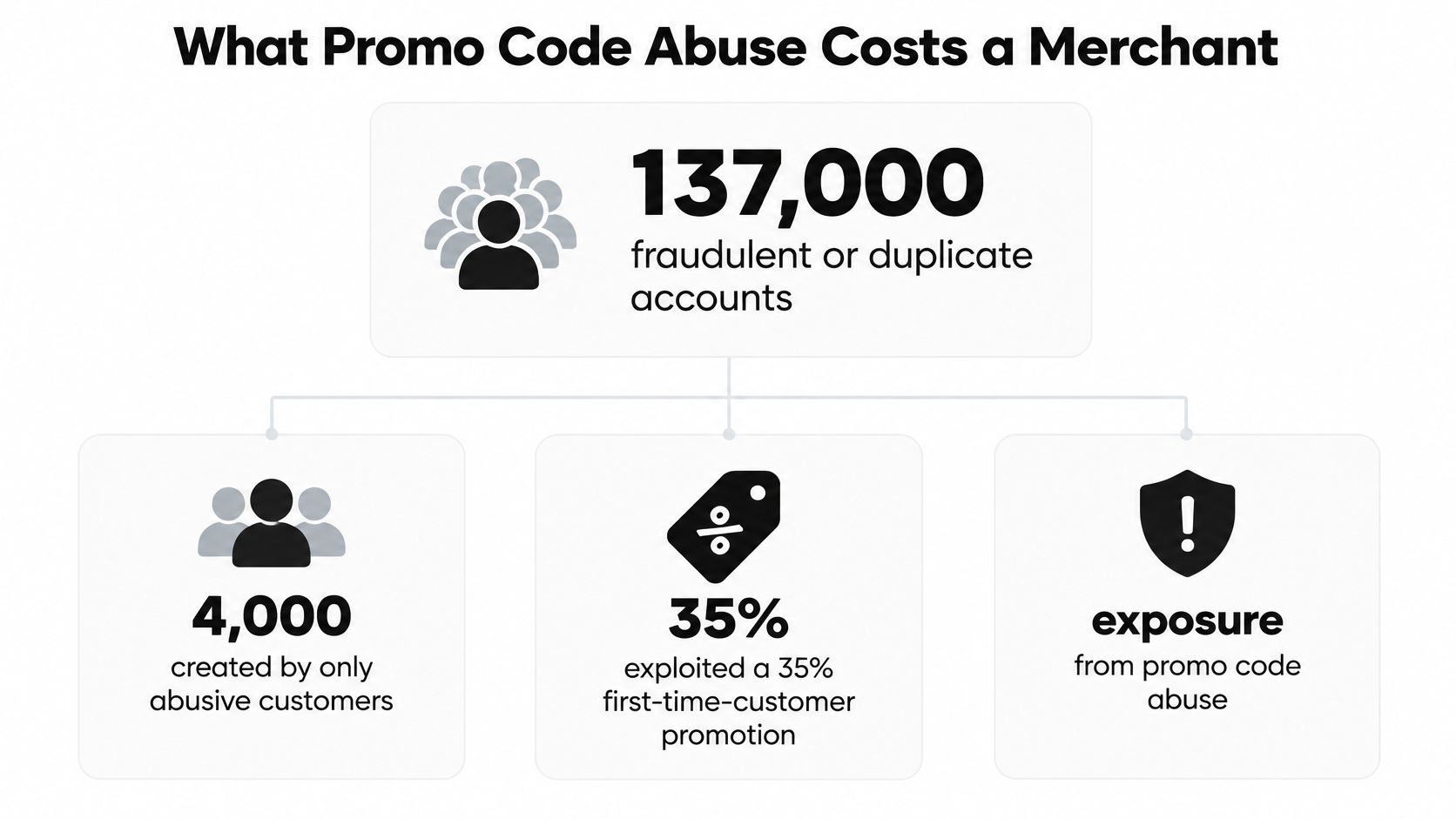
One large merchant discovered 137,000 fraudulent or duplicate accounts created by only 4,000 abusive customers, all aimed at a 35% first-time-customer promotion. The exposure was estimated at more than $14 million annually for the marketing department, as RetailWire reported on a Riskified analysis.
Four thousand people is a small town. It doesn't take a fraud ring to reach that number. It takes a welcome offer that resets every time someone types a fresh email address.
The wider numbers say that case isn't exotic. In the same discussion, 86% of retailers reported somewhat or very significant costs from promo-code or loyalty-program abuse, 38% said losses rose from 2021 to 2022, and 55% experienced abuse in both years. That last figure is the one to sit with. This is a persistent line item, not an incident you respond to once and close.
Why manual review loses at this scale
Thousands of linked accounts cannot be sorted by hand from legitimate household behavior. Two people at one address ordering at the same time is a normal Tuesday. Ten accounts at one address across three months, all redeeming the same new-customer code, is not. A human reviewer can't see either pattern across a spreadsheet of 40,000 orders, and the version that does exist in your head doesn't survive a busy quarter.
That's the argument for putting the cheap, boring rules in first: eligibility checked on the server, one redemption per identity, combination limits enforced rather than assumed. Stacking is the most common way a single order ends up discounted twice; if you've ever wondered why the effective rate on some orders runs past the advertised one, how coupon stacking works explains the mechanics well enough to write rules against.
Three numbers to track in your own store
- Discount cost per redemption: total discount value divided by redemptions, reviewed weekly. A rise without a matching campaign means leakage, not generosity.
- Repeat redemptions per customer: any customer with more than one use of a first-order or single-use code is a finding, not a rounding error.
- Share of orders using codes never distributed publicly: if that share climbs, your private codes are circulating.
Each is a five-minute query in your admin. Run them monthly and you'll spot a leak long before it reaches seven figures.
How Coupon Extensions Steal Affiliate Commissions
Say a shopper watches an influencer review a coffee grinder on Tuesday and doesn't buy. On Friday she searches for a discount, lands on a coupon site, and completes the order. The influencer created the demand. The coupon site collects the commission, because under last-click attribution the final click wins and the coupon tool's click replaced the influencer's tracking cookie somewhere between the search and the payment page.
The commission stacking breakdown from Xark documents that exact sequence: a new tab opens to hunt for the brand's code, or an aggregator applies one automatically, and the cookie changes hands before checkout finishes.
Two names describe the outcome. Commission stacking is the payout going to a partner that added a click and nothing else. Channel cannibalization is what it does to your program: the influencer who drives discovery sees declining attributed revenue, then either quits or renegotiates, and your best acquisition channel shrinks. The mechanical detail of how these coupon extensions intercept a checkout is worth understanding before you try to block them.
Run the arithmetic on one order
On a $100 order with a 10% affiliate rate, a coupon partner that contributed no demand costs you $10 you never needed to spend. That's on top of the discount it applied. Do that a few thousand times a month and it's a salary.
The fix is mechanical, not moral. Block codes injected by a browser extension at checkout, and when a shopper needs a discount, swap in a code that carries no affiliate fee. The discount still lands, the sale still completes, and attribution stays with the partner who earned it.
Audit step: reconcile affiliate payouts against referral-source reports for every order where a coupon tool was present. Flag partners whose payouts rise while their referred sessions stay flat.
Warning Signs in Redemption and Order Data
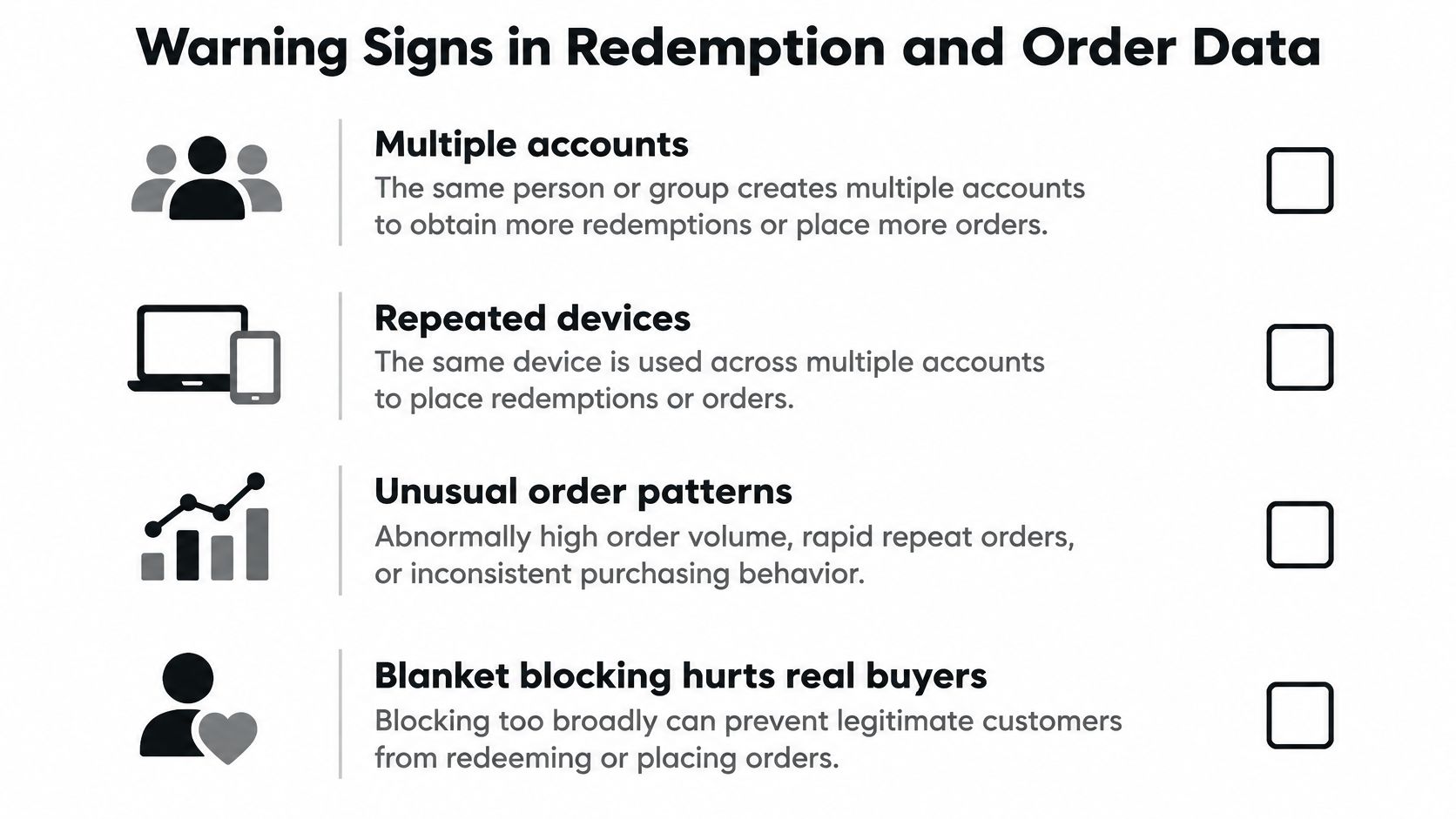
Promo abuse rarely looks like one person reusing one code. Research on Meituan's promotion systems characterizes it as group-based activity with recurring "stocking up" and cashback patterns, where coordinated users spread transactions across accounts, devices and orders rather than hammering a single identity. That's precisely why blanket blocking backfires: the pattern hides among legitimate behavior, and a hard block catches the family that shops together along with the ring.
Read the signals as a checklist, and pair each with what normal looks like.
- Redemption velocity: one code redeemed many times within an hour, measured against its own daily baseline. Normal is a smooth curve after a send.
- Account creation bursts: a jump in new accounts in the days right after a promotion goes live. Normal is a modest lift tied to the campaign's reach.
- Shared attributes: unrelated accounts using the same shipping address, card fingerprint or pickup point. Normal is a household with two or three genuine customers.
- Basket fingerprints: near-identical product mixes from accounts that share nothing else. Normal baskets vary with taste and budget.
- Post-purchase behavior: discounted goods returned, resold, or claimed back as cashback soon after delivery. Normal is a low, stable return rate.
Score combinations, not single signals
One signal is noise. Two is a conversation. Three is a case. A family shipping to one address triggers the shared-attribute signal alone, and a regional gift-buying week triggers basket similarity, so treat any single hit as a reason to look, never a reason to block.
Set the alert on combinations, escalate only the high-confidence clusters, and route everything else to standard checks. When a code is compromised, the response of choice is replacement rather than blank refusal: retire the exposed code, replace it with a controlled offer, and keep the checkout open. If you want the full teardown of how a code gets exposed in the first place, this explanation of how discount code leaks happen is worth twenty minutes.
Rule to apply this week: alert on any code whose hourly redemptions climb well above its own daily baseline. Baselines belong to individual codes, not to the store.
Prevention Controls Ranked by Effort and Impact
Coupon and discount abuse shows up often enough that the low-effort controls are worth turning on before anyone debates headcount. Two mechanics account for most of the loss: a code meant for a restricted audience landing on public coupon sites, and several offers combining past the limit you set. Detection is the signal that justifies a case. Enforcement is the control that runs by itself at checkout or on the server.
| Control | Abuse it stops | Effort | Where it runs |
|---|---|---|---|
| Single-use unique codes | Leaked and shared codes | Low | Checkout |
| One redemption per customer | Multi-accounting | Low | Account and order matching |
| Minimum order and stacking rules | Code stacking | Low | Checkout validation |
| Server-side eligibility validation | Every rule bypass | Medium | Server |
| Protected links for partner codes | Leaks to coupon sites | Medium | Link level |
| Extension blocking at checkout | Commission stacking | Medium | Checkout |
| Leak monitoring and takedowns | Exposed public codes | Low, ongoing | Coupon sites |
| Manual review of high-risk clusters | Organized abuse rings | High | Operations team |
Match each signal to one automatic action, and leave the rest for a person. A code found on coupon sites is a leak: retire it, and if a shopper enters that expired or fake code, swap in one approved recovery code so the sale still completes. Stacking past the cap is a rules failure: the server rejects the combination. An extension applying its own code at the till is commission stacking: block the extension before checkout. Clusters that do not fit a single rule wait in a manual queue. That split keeps investigation small, and an honest shopper gets a fallback instead of a hard stop.
The rollout order I would follow
Low-effort rows go in this week. They are mostly settings, not a project. Use single-use codes where the audience is finite. Cap redemption at one per customer, matched on email, phone and address. Put a minimum basket on deep discounts. Enforce stacking in the platform, not on the honor system.
Move employee, influencer and partner codes onto protected links next. The code redeems only through that tracked link, so a paste onto a coupon forum fails. Pair the links with leak monitoring and takedown requests. Stores skip that row because it never looks urgent, until the same code is sitting on public coupon pages and the margin is already gone. Leaving the scan running is cheap. A person is needed only when a listing sticks or a site writes back.
Extension blocking is the row that stops commission stacking at the till. I would turn it on before hiring anyone to watch orders. Keep manual review for organized clusters the rules cannot settle, and staff that queue as investigation rather than general customer service.
A secret code is not a control. If the only thing protecting a code is that nobody has posted it yet, you own a delay, not a defense. Validation at checkout is the control.
How to Triage the Cases Your Rules Cannot Decide
The expensive part isn't the rule set. It's the queue. According to Liminal's promotion and loyalty abuse research, only 20% of organizations enforce promo restrictions automatically, 96% of loyalty and referral abuse cases still require manual review, and 79% cite high labor costs as the barrier. That ratio is the whole argument for automating prevention and budgeting headcount for investigation.
Split the work into two tracks. Prevention runs without a person: eligibility checks, per-customer redemption limits, stacking caps, extension blocking. Investigation only receives what rules can't settle.
Then rank the queue by spend at risk and strength of evidence:
- Leaked public codes. Highest spend and a clear path to resolution, because a takedown request either removes the listing or it doesn't.
- Referral self-dealing. Small values, high volume, and cheap to automate with payout-hold rules.
- Loyalty point farming. Delayed cost, so it needs order and return data joined before anyone opens a case.
- Multi-account rings and stock-up resale. Lowest frequency, highest value per case, and dependent on link analysis across accounts.
Set a volume threshold
Pick a number of linked accounts above which a cluster goes to investigation, and leave single signals in standard checks. The threshold is arbitrary, but a fixed one stops the queue from filling with arguments about individual orders.
Log every case with the same fields: code, account age, shared address or device, decision, and whether a fallback offer was granted. Those fields are what let you re-rank the queue monthly with evidence instead of instinct.
Stop Abuse Without Turning Away Honest Shoppers
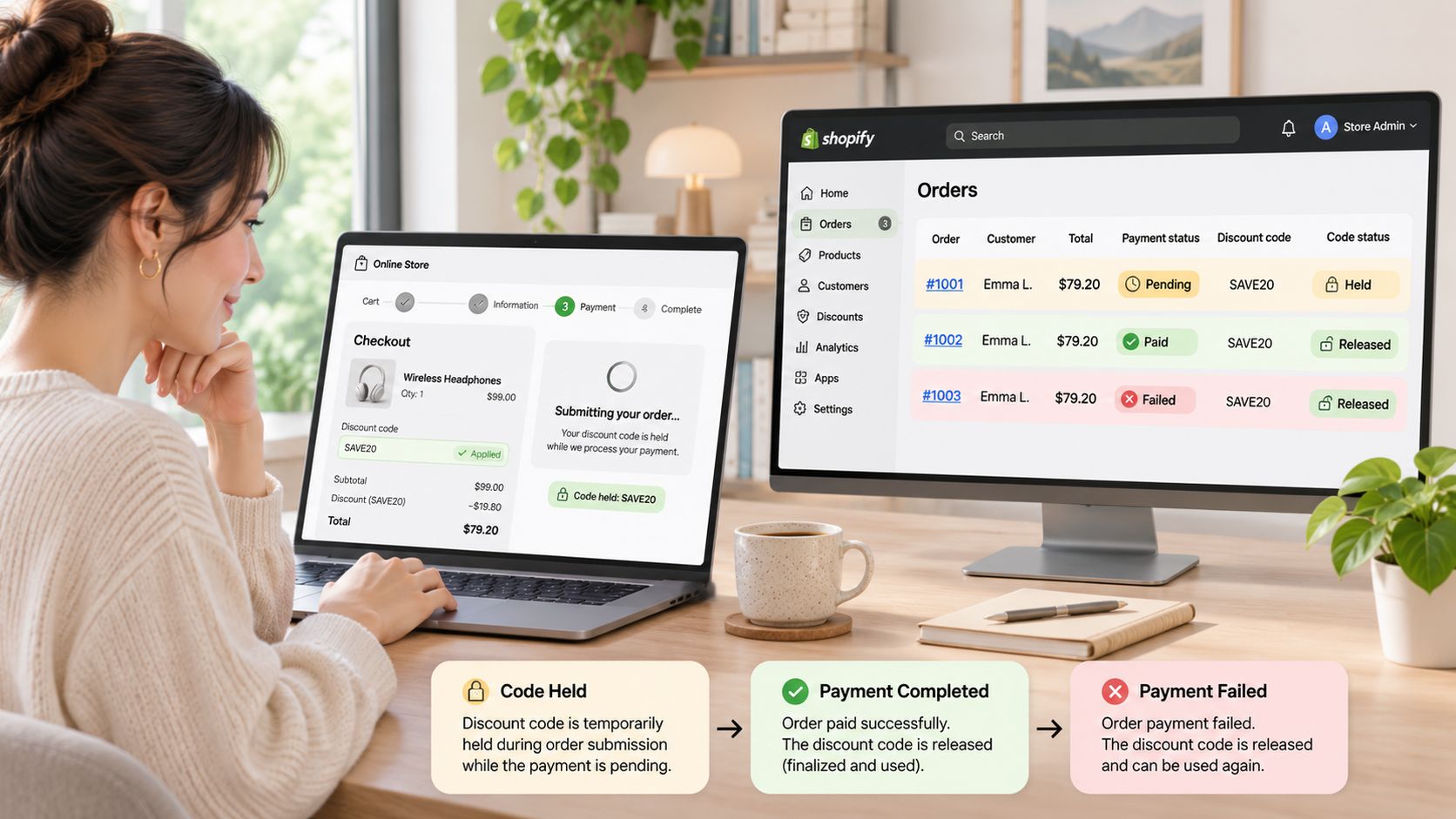
Start with a platform quirk that generates more support tickets than any fraud ring. Shopify's discount documentation explains that when a customer submits an order, the code is held against its usage limit until payment completes or fails. A declined payment releases the hold. But if a provider doesn't correctly report a failure, the hold can persist with no order behind it, and an unfinished checkout can keep holding a code when no matching order exists.
That's how an honest shopper gets told your code is invalid without ever having used it. Your reports need to separate completed orders, failed payments and abandoned checkouts before anyone concludes a code ran out.
The fallback rule, in order
- Confirm no completed order exists against that code and that customer. Holds aren't redemptions.
- Check the account for abuse signals: account age, shared address or device, prior redemptions.
- If the account is clean, issue one merchant-set fallback code. One, so it stays a courtesy rather than a new discount program.
- If signals are present, decline and log the case with the evidence attached.
The trade-off is structural, not sentimental. Generous policies are how retailers acquire and keep shoppers, and the same research that documents that appetite also shows the abuse sitting on the other side of the ledger. A blanket block costs conversion. A targeted fallback costs a discount you chose.
Log every fallback: code, order value, and the signals you checked. Then report the share granted to clean accounts against the share granted to flagged ones each month.
If those two shares start converging, your rules are either too tight or your signals are broken. Either way, you now have the data to tell which.
Time Your Code Controls Around Peak Abuse Windows
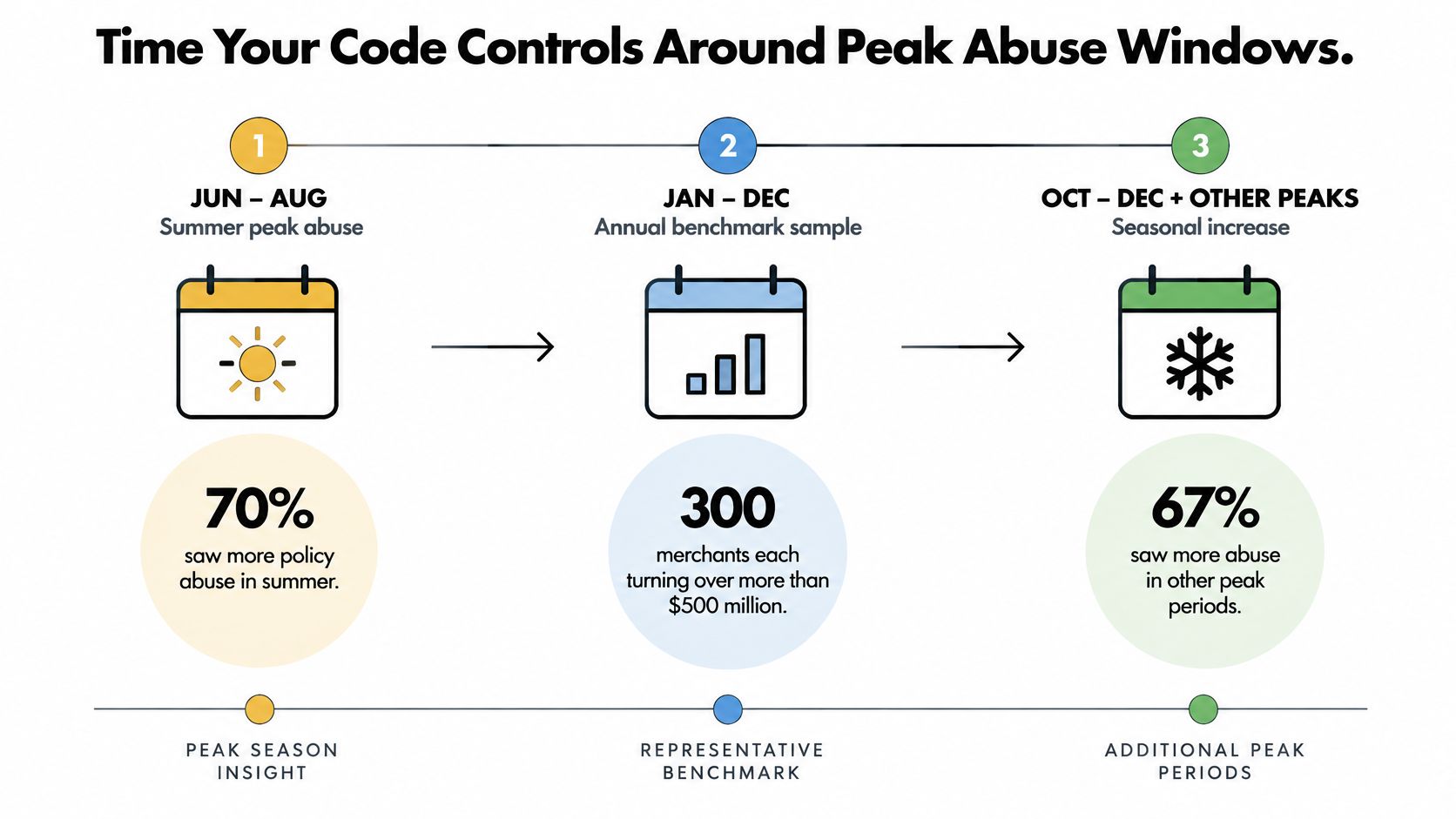
Anchor this work to dates, not resolutions. A benchmark of 300 merchants, each turning over more than $500 million a year, found that 70% saw more abuse during the summer season and 67% saw more during the post-holiday returns period. Abuse follows your promotional calendar and your returns calendar, because that's when volume gives cover.
So build a calendar of your own.
Four weeks before a campaign: list every live code with its intended audience, expiry date, and whether it's partner-only. Three weeks out: move high-value and partner codes onto single-use codes or protected links. One week out: turn on leak alerts and takedown tracking, which are off by default in most setups. On Shopify, no email is notified when a coupon leak is found until you enter alert addresses in the settings, so a store can be leaking for weeks with nobody watching. During launch: compare hourly redemptions against each code's own baseline. A month after: rerun the three cost metrics, review the fallback log, and reconcile affiliate payouts against referral sources.
Rules that block everything cost you conversion; cluster flags protect margin without touching the honest buyer. If those checks still run by hand every week, that's where automation earns its keep. KeepCart blocks more than 120 coupon extensions, including Honey, RetailMeNot, Karma and Capital One Shopping, before they reach checkout, and when a leaked code is detected it contacts the coupon site on the store's behalf to request removal.
KeepCart is coupon protection built for Shopify stores, combining checkout extension blocking, daily scanning of the major coupon leak sites, automated takedowns, Protected Links for partner codes and discount recovery when a code fails. It runs on every Shopify plan, and setup takes minutes rather than a developer sprint. If your discount codes are still guarded by nothing more than an email address checkbox and hope, take a look at KeepCart and see what your checkout looks like with the leaks closed.