Influencer Discount Codes: How to Control and Track Them
Influencer discount codes explained: how they work, how to set limits, track real sales and stay compliant, with practical steps for brands.
Influencer discounts are getting shallower, not deeper. A 2025 analysis of more than 900,000 influencer codes found the average creator discount fell from 19.1% in 2022 to 15.0% in 2025, and in four of seven major categories influencer discounts were equal to or lower than standard codes (SimplyCodes influencer promo code study). Whatever a creator code is worth to a brand, it isn't the size of the price cut.
That leaves the part most guidance skips. A creator code is a commercial asset with three costs attached: the margin you hand over, the commission you pay, and the disclosure you owe. Brands usually manage the first badly, measure the second generously, and forget the third until a creator's post gets flagged.
What follows is how these codes behave once a creator's audience gets hold of them, and the settings, checks and decisions that keep one string of characters from turning into an unmanaged discount.
What Influencer Discount Codes Are and Why Brands Use Them
Maya posts a 40-second video about a serum. A shopper watches it on her phone, doesn't tap the link in the bio, and closes the app. Nine days later she's at checkout on a laptop and types MAYA15 into the discount field. She pays less, the order carries Maya's code, and Maya earns commission on a sale she influenced without a single click.
An influencer discount code is that string of characters: a personalized coupon that names the creator, gives the shopper a reason to buy now, and tells the merchant which creator gets credit. Treat it like a name tag at a free sample table. Anyone can hand out the sample, but the name tag tells the staff who to thank and who gets paid at the end of the shift.
The code is the smallest asset in a creator campaign and the one that carries the most weight.
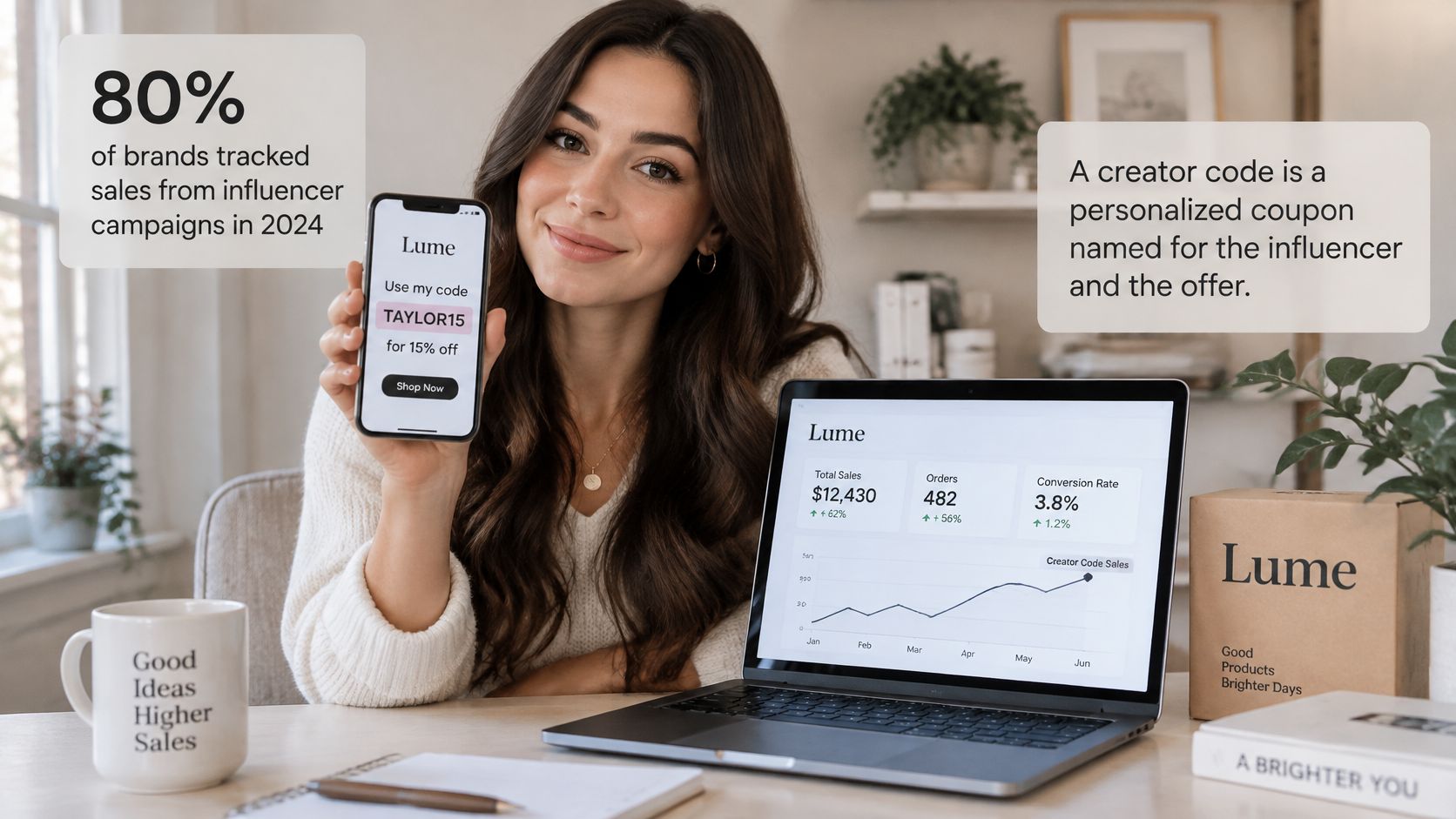
Three jobs inside one string
- A discount rule. It sets the price the shopper pays, so its value comes straight out of margin.
- A creator identifier. It survives screenshots, group chats and word of mouth, which is where most referral links stop working.
- A commission trigger. It decides who gets paid and how much, so it belongs in your affiliate tool as well as your store.
Get one of those wrong and the other two stop paying for themselves. A code with no owner produces revenue nobody can attribute. A code with no commission rule produces a creator who stops mentioning it.
Attention is a separate problem from attribution. In 2024, 64% of surveyed consumers said genuine and unbiased influencer reviews were the influencer content they were most likely to engage with, while 55% selected discount or promo codes, according to Sprout Social's research on influencers and purchasing decisions. Read that as a hierarchy. The code earns a click. The review earns the trust that makes the click worth making. A credible creator with an ordinary offer outperforms a forgettable one with a deep discount.
What separates a code from a link is durability. Someone who hears a creator read a code on a podcast can type it at checkout three days later, on a different device, and the sale still lands. That durability is exactly why a creator code needs an owner, a lifespan and a budget instead of a fresh string of characters every time someone asks for one.
Code Settings That Decide Who Can Redeem Your Offer
Shopify puts more controls on a discount code than most brands use. The Shopify discount settings guide covers expiration dates, usage limits, minimum order requirements, product or collection restrictions and discount-combination rules. Each one answers a specific way an influencer code goes wrong after launch.
| Control | What It Does | What It Prevents |
|---|---|---|
| Expiration date | Ends the code on a set date | Old creator codes resurfacing on coupon sites months later |
| Total-use cap | Limits redemptions across all customers, such as 200 uses | Campaign volume running past budget |
| One use per customer | Blocks repeat redemption by the same email or phone number | One shopper reusing a creator code again and again |
| Minimum order | Requires a set spend before the code applies | Small baskets receiving the full creator discount |
| Product or collection limits | Restricts the code to chosen items or collections | Discounts on bestsellers that never needed a push |
| Discount combination rules | Sets which discount classes can stack together | Creator codes stacking with sitewide sales |
| Per-order code limit | Caps a single order at five product or order codes plus one shipping code | Unexpected stacking beyond the planned offer |
Total-use cap versus one use per customer
These two settings look interchangeable and aren't. A total-use cap counts redemptions across the entire customer base, so a limit of 200 uses means the 201st shopper is refused no matter who they are. A one-per-customer rule reads the shopper's email address or phone number and stops that person repeating the offer while leaving the code alive for everyone else (Shopify's percentage and fixed amount discount documentation).
Use both, and set the cap from the campaign budget rather than from the creator's follower count. A creator with 40,000 followers should never generate thousands of redemptions from a code you expected to run a few hundred times. When that happens, the code has travelled, and the extra volume is discount abuse with somebody's name attached to it.
Stacking is where the margin disappears
Say Maya gets MAYA15: 15% off, live for two weeks, capped at 200 uses, one per customer, restricted to the skincare collection, with a minimum order before it applies. Six settings, one offer, and none of it depends on Maya remembering the rules correctly.
Then a sitewide sale starts in week two. Shopify lets you decide which discount classes stack, and it caps a single order at five product or order discount codes plus one shipping code (Shopify's discount combinations guide). Whether MAYA15 stacks is your setting. Whether it should is a margin calculation you run before the campaign, not a surprise you find at checkout.
The same discipline applies to any exclusive discount code you hand to a partner or an employee. The narrower the audience, the more a leak costs, because the offer was never priced for public volume.
The rule I'd enforce: no creator code leaves the brand without an end date and a cap, even for a creator you've worked with for two years.
How to Set Up a Creator Code Step by Step
A creator code is built in two systems that have to agree: the store, where the discount applies, and the affiliate tool, where the creator is credited. Set them up in this order.
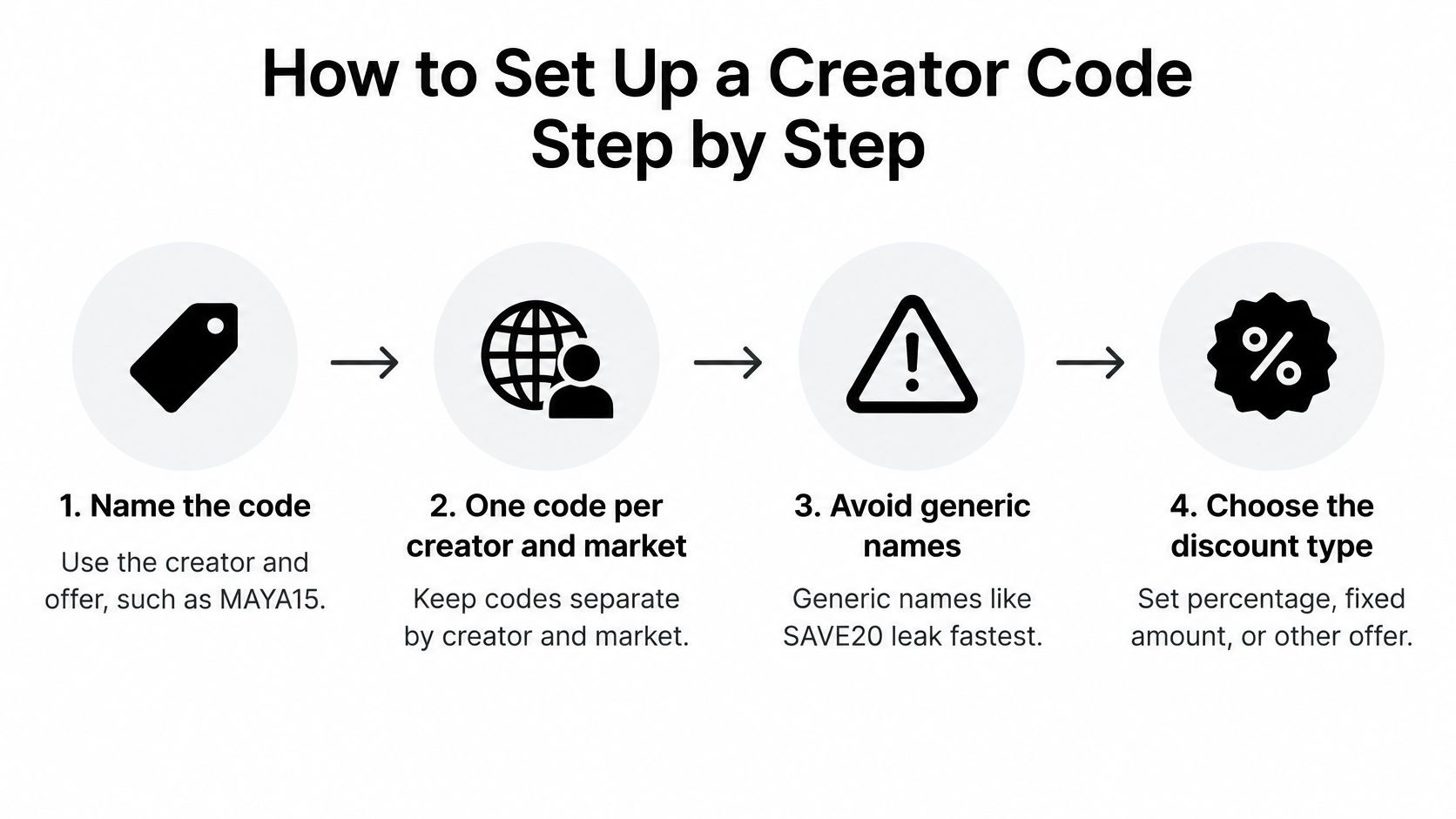
The naming and scoping decisions do most of the work. Everything after them is arithmetic.
- Name it after the creator and the offer. MAYA15 gets remembered and spoken correctly. SAVE20 can't be attributed, tells the shopper nothing about who sent them, and leaks fastest because it reads like a public promotion. Add a market suffix when you sell in several currencies, such as MAYA15-UK, so a leak in one market doesn't contaminate another.
- Pick the discount type and price it off your margin. Percentage or fixed amount, then test the number against contribution margin after commission. The slip here is choosing a percentage because it looks standard for the category rather than because the product can carry it.
- Set the start and end dates from the content calendar. Start when the first post goes live and end a few days after the last one to catch late viewers. A code without an end date is still circulating next year, and by then nobody remembers who owns it or why it exists.
- Cap the redemptions and limit one use per customer. The cap protects the budget. The per-customer rule stops one shopper from hammering the offer. Both need a number before anyone shares the code, never after the first redemption spike.
- Restrict the scope. Tie the code to the collection the creator promoted and set a minimum order. Without that, the discount lands on bestsellers that sell themselves and on small baskets that weren't worth discounting.
- Record the creator and the commission rule in your affiliate tool. Same code, same dates, same limits, plus the commission base. Decide whether commission is calculated on the price paid or the price before discount and write it into the agreement. That single ambiguity causes more payment disputes than any other.
- Test it before you hand it over. Place a live order with the code, confirm the discount applies, confirm the commission records against the right creator, then send the code to the creator with the approved disclosure wording attached. Codes get shared before they're tested all the time, and the failure only shows up in a public post.
The check to run in week one
Compare three numbers per creator after the first week: gross orders that used the code, net revenue after the discount, and commission cost. If commission cost climbs faster than net revenue, the code is paying for demand you already had, and no amount of extra reach fixes that.
Tracking Sales Without Overcounting Your Creators
A creator code proves who was named at checkout. It doesn't prove the shopper would have left without it, and that gap is where most creator reporting goes wrong.
In 2024, 80% of brands reported tracking sales from influencer campaigns, and among the methods they used, email addresses accounted for 30%, referral links for 28% and coupon codes for 14%, according to Whop's influencer marketing statistics. Codes are the smallest of the three in that survey. They're also the only one that works when nobody clicks.
| Attribution Method | Brands Using It (2024) | Strength | Blind Spot |
|---|---|---|---|
| Email addresses | 30% | Identifies buyers who opted in | Misses shoppers who never give an email |
| Referral links | 28% | Tracks the click through to the sale | Breaks when a shopper types a code instead |
| Coupon codes | 14% | Names the creator and works without a click | Codes leak onto coupon sites and extensions |
Whichever method leads in your program, none of them answers the question your finance team asks.
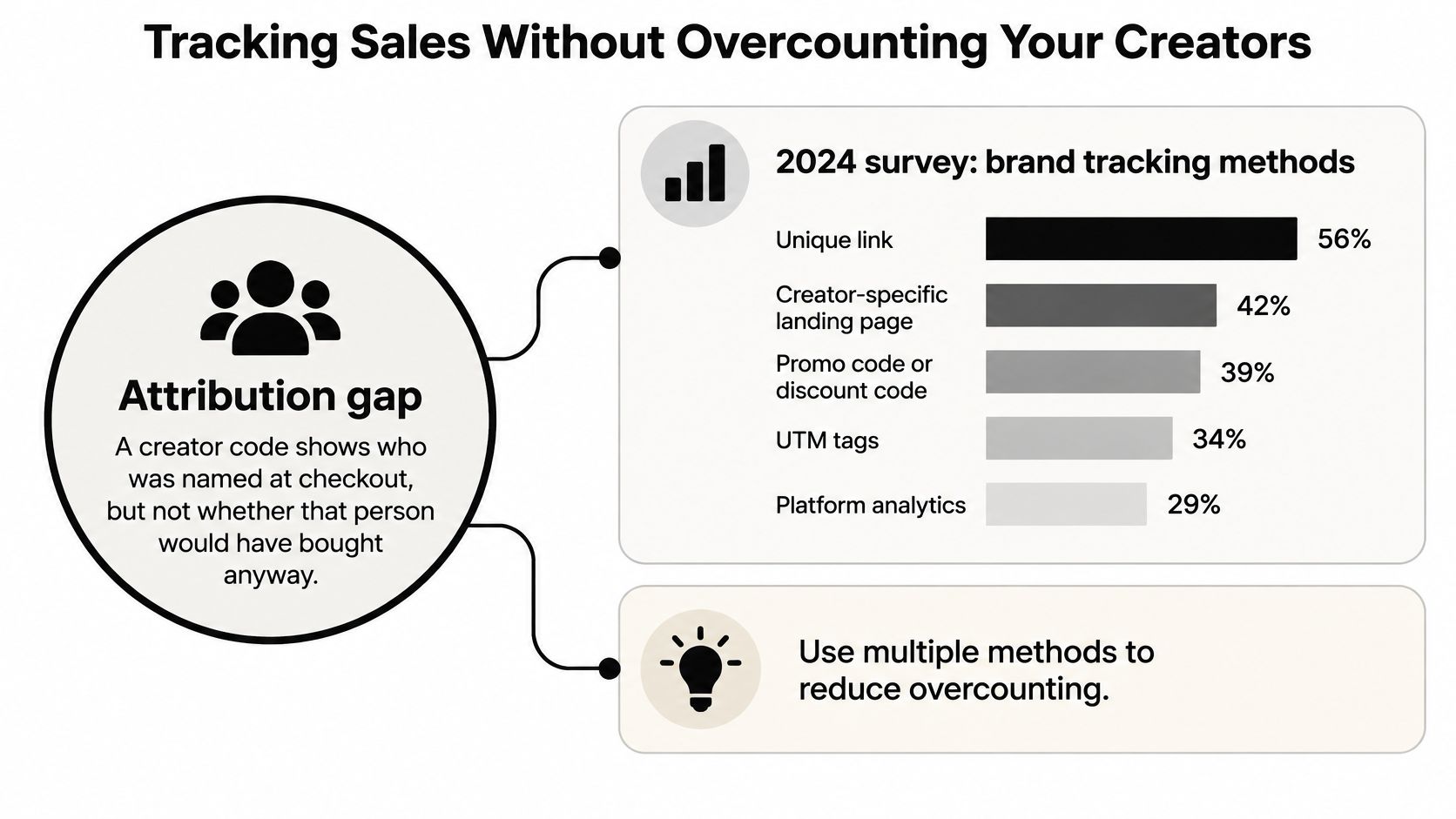
The funnel behind a single redemption
The largest field study on this measured 2,808 influencer-specific codes across 1,881,533 product sales worth more than €17 million, generated from sponsored Instagram posts by 1,698 creators across nano, micro and macro tiers (Journal of Marketing research on influencer codes). Its conclusion is the one worth keeping: code-level reporting connects a transaction to a specific creator, but it does not measure that creator's entire causal contribution.
The researchers model the path as a funnel. Exposed followers have to become reached users, then engage, then purchase. A redemption sits at the end of that path, which means it carries every leak and every already-convinced buyer along with it.
Why 400 orders is not 400 sales
Say a creator's code brings in 400 orders this month. Pull the buyer list and 150 of them were already on your email list, had bought within the year, or arrived while a public sale was running. Those 150 are discounts you paid for demand you already had. The number worth reporting is the other 250, minus whatever share a holdout shows you wouldn't have converted anyway.
Compare code-attributed orders against a pre-campaign baseline, a holdout segment, or randomized geographic exposure. That's how you separate genuine incremental demand from customers who were already going to buy. Splitting gross orders, net revenue after discount and incremental conversions into three columns takes an afternoon and changes every renewal conversation after it.
Then reconcile the two paths. Decide which one wins when a shopper clicks a tracked link, abandons, and comes back to type the code, because your affiliate tool will pick one and you want it to be your rule rather than its default.
Why a Creator Code Alone Is Not Enough Disclosure
A code reading MAYA15 looks like transparency. The Federal Trade Commission has said it usually isn't enough.
In September 2017, the agency stated that a clearly personalized code, such as one incorporating an influencer's name and a percentage discount, probably communicates that a relationship exists between the influencer and the brand, but may not make clear that the influencer receives payment when the code is used. Where a significant minority of consumers might not understand the financial connection, the FTC advised a clearer disclosure (FTC endorsement guides).
That came after an April 2017 outreach in which FTC staff sent more than 90 letters to influencers and marketers about disclosing material connections, including payment and free products. The case that still gets quoted in briefings is the 2016 Lord & Taylor matter, where the agency alleged the retailer used 50 Instagram posts and captions from fashion influencers without adequately disclosing that they were paid endorsements.
A discount code is not a substitute for disclosure. It's the reason disclosure matters more.
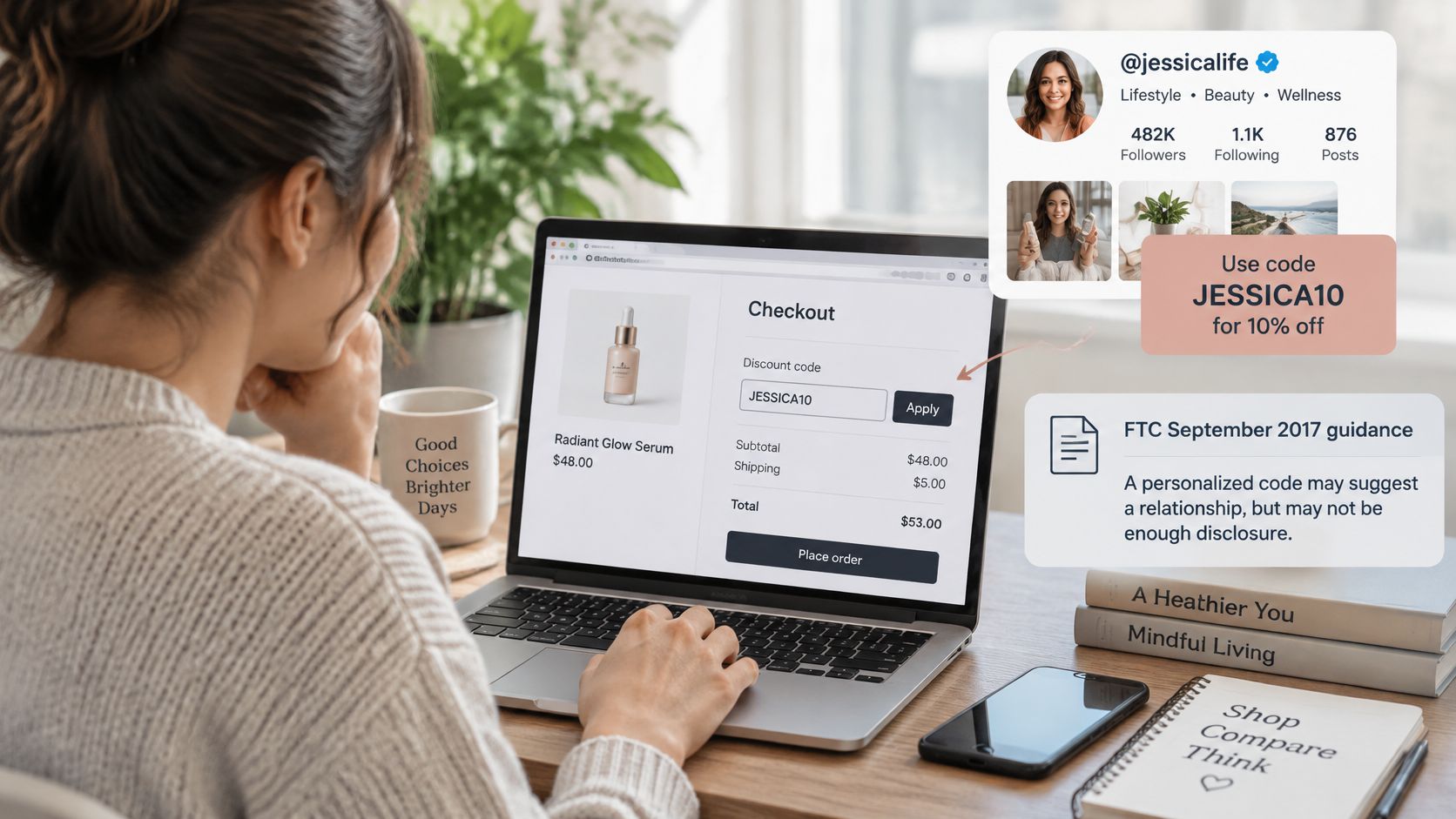
What the experiment showed
In a randomized 2x2 online experiment with 353 participants, researchers varied whether an Instagram post contained a discount code and whether it carried a sponsorship disclosure. Without a disclosure, adding the code significantly increased participants' recognition that the content was advertising, and that recognition reduced perceived influencer trustworthiness, which then pulled down brand attitude. With a disclosure present, participants showed high advertising recognition whether or not a code appeared (study on discount codes and advertising recognition). The label does the transparency work. The coupon can't.
Four lines for the next creator brief
- Standard wording everywhere. Caption, video, livestream and the landing page the creator links to all carry the same disclosure, localized into the language of the market.
- Disclosure before the call to action. A label buried below the instruction to use the code is easy to miss, and it argues against you in any review of the post.
- Free or discounted product counts. Gifted product is a material connection even when you never asked for a review.
- Report disclosed and undisclosed placements separately. A code's conversion rate means something different when the audience knew they were watching an ad.
Run those four and the code's numbers become comparable across creators. Skip them and you're comparing a disclosed post against an undisclosed one and calling the difference performance.
The Hidden Margin Cost of Cheap Creator Codes
Creator codes look expensive because of the discount. The discount is rarely the biggest cost.
In 2024, influencer discount codes averaged a 12.3% discount across 847 tracked transactions, according to Herm's analysis of 23 major e-commerce retailers. That's the visible number. The invisible one is what the same order costs once commission lands on top of the reduced price.
The $80 order, line by line
Take an $80 order, a 15% creator code and a 10% commission on the discounted price.
- Discount: 15% of $80 is $12, leaving $68.
- Commission: 10% of $68 is $6.80.
- Total cost of the sale: $18.80, or 23.5% of the order value, before product cost, shipping or payment processing.
Run the same $80 order through a public 10% sitewide sale and the brand is ahead. Run it through a creator code that stacks with that sitewide sale and the 23.5% gets worse while the shopper feels like they got a private deal.
Three costs the dashboard doesn't show
- Discounts on sales you already had. A shopper who would have paid full price and spots a code at checkout costs you the discount and the commission, and looks like growth in the report.
- Commission on sales the creator didn't drive. Leaked codes and coupon extensions attach a creator's name to orders that never saw the post, and you pay for every one.
- A public promotion that was cheaper. A code can feel exclusive while giving away more than the sitewide offer you'd have run anyway, so the exclusivity is a feeling, not a price advantage.
Before renewing anyone, compare five measures: incremental conversion, new-customer rate, margin after discount, commission cost per net sale, and overlap with public promotions. A creator who wins on gross revenue can lose on all five, and the report that shows only gross revenue will keep recommending them.
What to Do When a Creator Code Leaks Onto Coupon Sites
A leaked code doesn't stop working. It keeps selling, which is the problem, because every redemption is a discount plus a commission paid to someone whose content played no part in the sale.
- Detect. Search each live code on the coupon sites and browser extensions your customers use, and read order logs for redemptions from regions, audiences or dates the creator never reached. Redemptions clustering in the days after a listing appears tell you what the leak cost. Leak detection runs continuously on our side, scanning coupon sites and forums and filing removal requests on the store's behalf, which shortens the gap between the first listing and the last redemption.
- Contain. Drop the total-use cap to the number already redeemed plus a small buffer, or pull the end date forward so the code dies when the campaign does. Either move stops the bleeding without touching any other creator's offer.
- Replace. For a serious leak, retire the code and issue a replacement with a new name, such as MAYA15B, then tell the creator to stop sharing the old one. Mark the leaked redemptions in your records so her results aren't inflated, and recalculate gross orders and net revenue without them.
- Prevent. Keep codes out of public bios, giveaways and open comment threads, apply one use per customer, and issue codes per creator and per market so a leak in one country doesn't expose the whole program.
The point of all four moves is speed, not punishment. Creators don't leak codes on purpose. Audiences screenshot them, and coupon sites do the rest.
Review Each Creator Code and Decide Its Fate
Two weeks after a code goes live, it has a verdict waiting. Review each one on four measures: gross orders it produced, net revenue after discount, incremental conversions, and commission cost per net sale. Add the margin effect of every discount and commission, plus the share of orders that overlapped with a public promotion.
Then give the code one of three answers.
- Renew when margin holds and most buyers are new or incremental, which is the only combination that justifies doing it again at the same terms.
- Adjust when the discount, minimum order or product scope is leaking margin. Narrow the scope, raise the minimum, or cut the percentage before you cut the creator.
- Retire when the code mostly reaches buyers who'd have paid full price, or when it has spread onto coupon sites you don't control. A code you can't govern is a permanent discount with a person's name on it.
Decide on margin, not redemption count, and put the next review on the calendar before the next post goes live. Start with two or three creators whose audiences match your best-margin products, so the first review tests the offer where it can earn the most and the answer is easy to act on.
KeepCart keeps creator codes inside the campaign you planned, blocking the coupon extensions and leaked listings that attach a creator's name to orders they never drove. Protected Links tie an exclusive creator offer to the exact link you gave that creator, and when a blocked code is entered at checkout, KeepCart swaps in a valid, non-fee code so the sale still goes through. Visit KeepCart to put your next influencer discount code behind controls that report back.
Refined using the Outrank tool